
- May 29, 2026
- 363
- Culture
For decades, global conversations about Islam have revolved around the Arab world. Television cameras point toward Mecca, Medina, Baghdad, Damascus, and Cairo whenever the subject of Muslim civilization comes up. That framing shaped how millions of people understand the Islamic world.
But it also created a major blind spot.
Because far away from the deserts of Arabia, another Islamic giant has been growing quietly for centuries. Not in the Middle East. In West Africa. In Nigeria.
The numbers are staggering.
Nigeria today has a Muslim population estimated at well over 100 million people, larger than the entire population of many Arab nations commonly associated with Islam. In raw demographic terms, Nigeria now surpasses countries like Saudi Arabia, Iraq, and Syria in Muslim population size.
Yet many outside Africa still do not realize this.
Search data increasingly shows people asking questions like “Does Nigeria really have more Muslims than Saudi Arabia?” or “Which African country has the largest Muslim population?” The surprise behind those searches says everything about how global narratives have ignored Africa’s place in Islamic history.
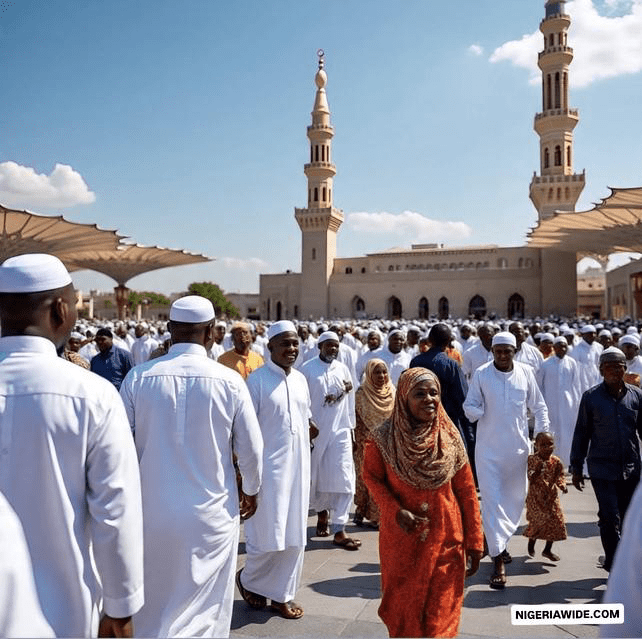
Walk through Kano during Friday prayers.
Stand near the ancient mosques of Sokoto. Watch the packed Eid grounds in Kaduna, Maiduguri, Katsina, Ilorin, and Zaria. Listen to the Adhan echoing through old commercial districts that have practiced Islam continuously for centuries.
Then the misconception begins to collapse.
Nigeria is not standing at the edge of the Islamic world. It is one of its demographic centers.
And the roots of that reality stretch back over a thousand years.
The Numbers the World Keeps Underestimating
The global Muslim population is often mentally tied to the Arab world because of Islam’s origins in the Arabian Peninsula. Spiritually, that connection is undeniable. Mecca and Medina remain the heart of Islamic worship.
Demographically, though, the story changed long ago.
Today, the world’s largest Muslim populations are concentrated mostly outside the Arab world. Countries like Indonesia, Pakistan, India, Bangladesh, and Nigeria now dominate global Muslim demographics.
Nigeria’s position surprises many people most.
Current demographic estimates place Nigeria’s Muslim population between 100 million and 110 million people. That number alone places the country among the largest Muslim populations anywhere on Earth.
Compare those figures carefully.
| Country | Estimated Muslim Population |
|---|---|
| Nigeria | 100–110 million |
| Saudi Arabia | 32–34 million |
| Iraq | 40–43 million |
| Syria | 18–20 million |
| Jordan | 10–11 million |
| United Arab Emirates | 8–9 million |
| Libya | 7 million |
| Lebanon | 3–4 million |
The contrast is dramatic.
Nigeria’s Muslim population alone exceeds the total population of several Middle Eastern nations combined. Yet because Nigeria is rarely centered in international discussions about Islam, many people still assume the Arab world numerically dominates the religion.
It does not.
The Arab world remains spiritually and historically central to Islam, but the demographic center of gravity has shifted heavily toward Africa and Asia. Nigeria stands directly inside that transformation.
This reality also explains why phrases like Muslim population in Nigeria vs Saudi Arabia and largest Muslim countries in Africa continue attracting massive search traffic online.
People are discovering a reality hidden in plain sight.
How Islam Reached Nigeria Centuries Before Colonial Rule
Islam did not arrive in Nigeria recently.
It was not introduced by modern politics. It was not imported during colonial rule. By the time British colonial administrators appeared in West Africa, Islam had already spent centuries shaping kingdoms, trade systems, scholarship networks, and social life across large parts of what would later become Nigeria.
The story begins in the Sahara.
From around the 11th century onward, trans-Saharan trade routes connected North Africa to the powerful Kanem-Bornu Empire near Lake Chad. Those caravan routes became highways of religion, commerce, education, and political influence.
Camels carried more than goods.
Salt traveled southward from the Sahara. Gold, leather, ivory, kola nuts, and textiles moved northward toward Tripoli and Cairo. Alongside these commodities came Muslim traders, scholars, clerics, and Quranic teachers carrying Islamic knowledge into West Africa.
Religion spread gradually.
The rulers of Kanem-Bornu embraced Islam centuries ago, beginning with royal conversions that eventually transformed governance itself. Islamic law influenced administration. Arabic literacy expanded. Quranic education became tied to elite political culture.
Soon, the region became deeply connected to the wider Muslim world.
Pilgrims traveled from Bornu toward Mecca. Scholars moved between West Africa and North Africa exchanging manuscripts and theological ideas. Islamic learning flourished around Lake Chad, where courts, mosques, and scholarly institutions expanded steadily.
This was not cultural imitation.
It was civilization-building.
By the 13th and 14th centuries, Kanem-Bornu had become one of sub-Saharan Africa’s strongest Islamic empires. Historians from North Africa wrote admiringly about its political organization, military power, and intellectual life.
The Hausa city-states pushed Islam even further.
Cities like Kano, Katsina, Zaria, Gobir, and Daura emerged as thriving commercial centers tied directly to trans-Saharan commerce. Markets overflowed with imported fabrics, horses, metal goods, and local products traded across enormous distances.
Islam grew naturally inside these cities.
Merchant families funded mosques. Islamic judges settled disputes. Quranic schools multiplied rapidly. Arabic became important for administration and scholarship while local languages absorbed Islamic vocabulary and ideas.
Katsina evolved into a major intellectual center.
Students traveled there from across West Africa seeking religious education. Scholars copied Arabic manuscripts by hand. Teachers debated theology, jurisprudence, astronomy, grammar, and philosophy within expanding networks of Islamic scholarship.
Then came the Sokoto revolution.
In the early 19th century, the Islamic reform movement led by Usman dan Fodio transformed northern Nigeria permanently. His campaign criticized corruption, weak religious practice, and political injustice among existing rulers.
The result was the creation of the Sokoto Caliphate, one of the largest pre-colonial states in African history.
Its influence spread across vast territories.
Islamic legal systems expanded. Scholarship networks intensified. Quranic schools multiplied. Emirs governed provinces connected intellectually and politically to Sokoto’s leadership structure.
That legacy still shapes Nigeria today.
Many traditional institutions in northern Nigeria trace their roots directly to the Sokoto system. Emirs remain influential. Islamic education remains deeply embedded within society. Religious scholarship continues to command enormous respect across communities.
The Southwest experienced a different pattern.
Islam spread gradually into Yoruba territories through trade, migration, urbanization, and diplomacy. Cities like Ilorin became major Islamic centers linking northern and southwestern Nigeria through scholarship and commerce.
Yoruba Muslim communities developed their own identity.
Islam blended with local language, dress, social customs, and cultural traditions without erasing Yoruba heritage. That flexibility helped the religion spread steadily throughout parts of Lagos, Ibadan, Ijebu, and surrounding regions.
This matters historically.
Islam in Nigeria did not emerge as a foreign transplant disconnected from local realities. It became deeply Africanized while remaining connected to global Islamic traditions.
That dual identity remains one of the defining features of Nigerian Islam today.
Nigeria’s Islamic Influence in the Modern World
Population eventually creates influence.
Nigeria’s massive Muslim demographic now shapes economics, diplomacy, religious travel, politics, education, and culture across Africa and beyond.
The annual Hajj pilgrimage is one clear example.
Every year, Nigeria sends one of the largest contingents of pilgrims from Africa to Saudi Arabia. Thousands travel through coordinated systems involving state pilgrimage boards, airlines, health officials, and diplomatic channels.
Saudi authorities pay close attention.
Nigeria’s sheer size guarantees relevance within broader Muslim affairs. The country represents too large a segment of the global Muslim population to ignore.
Economic influence is growing too.
Islamic finance has expanded rapidly inside Nigeria over the last decade. Sukuk bonds issued by the federal government have helped fund major infrastructure projects including highways and transportation development.
Investors from Gulf countries increasingly view Nigeria as a strategic economic partner because of its large Muslim consumer market.
The Halal economy represents another major opportunity.
Nigeria possesses enormous agricultural capacity alongside large domestic demand for Halal-certified food products, cosmetics, pharmaceuticals, fashion, and financial services. Analysts increasingly see the country as a future powerhouse in the global Halal market.
Northern Nigeria plays a major role here.
Its livestock industry, agricultural output, leather production, and food processing sectors already position the region as a potential export hub for broader African and Middle Eastern markets.
Culture matters too.
Hausa-language Islamic media reaches audiences across West Africa. Nigerian scholars attract followers internationally through digital platforms. Religious lectures produced in Kano, Kaduna, Sokoto, and Ilorin now circulate globally online.
This visibility is changing perceptions slowly.
For decades, international media discussions about Islam largely focused on Arab politics while African Muslim societies received little attention unless conflict dominated the headlines. Nigeria challenges that imbalance directly.
The demographic facts are impossible to ignore forever.
Africa’s Muslim population is growing rapidly, and Nigeria sits at the center of that growth. The future of global Islam will increasingly involve African voices, African scholarship, African commerce, and African political influence.
Nigeria is already part of that future.
Why Many Foreigners Still Misunderstand Nigeria’s Religious Reality
Part of the misunderstanding comes from media representation.
When many outsiders think about Nigeria internationally, they often encounter stories focused on oil, corruption, elections, entertainment, migration, or insecurity. Religion enters the conversation mostly during moments of crisis.
That creates a distorted image.
The daily religious life of ordinary Nigerian Muslims rarely appears in global storytelling. International audiences seldom see the intellectual traditions of Kano, the centuries-old Islamic scholarship of Sokoto, or the culturally integrated Muslim communities of southwestern Nigeria.
Instead, they see fragments.
But Nigeria’s religious landscape is far more layered than outsiders assume.
The country contains one of the world’s largest Muslim populations while simultaneously hosting one of Africa’s largest Christian populations. Entire regions have centuries-long histories of coexistence, intermarriage, commercial partnership, and shared cultural identity across religious lines.
That complexity matters.
Nigeria is not an Islamic republic like Saudi Arabia, nor is it a uniformly Muslim country. It is a deeply diverse federation where religion intersects constantly with ethnicity, geography, politics, language, and history.
Understanding Nigerian Islam requires understanding Nigeria itself.
And Nigeria rarely fits simplistic narratives.
Frequently Asked Questions
Which African country has the highest Muslim population?
Nigeria has the largest Muslim population in Africa by total numbers. Estimates place the country’s Muslim population above 100 million people, making it one of the world’s largest Muslim demographic centers overall.
Countries like Egypt and Algeria have very high Muslim population percentages, but Nigeria’s enormous total population gives it a larger Muslim population numerically.
Is Nigeria an Islamic country?
No. Nigeria is constitutionally a secular federation.
The country contains large Muslim and Christian populations alongside traditional religious communities. Northern states tend to have Muslim majorities, while many southern regions are predominantly Christian.
Islam strongly influences culture and public life in parts of Nigeria, but the constitution does not declare Islam as a state religion.
How did Islam spread in Nigeria?
Islam spread into Nigeria mainly through trans-Saharan trade routes, scholarship networks, migration, and political expansion. Muslim traders and clerics introduced Islamic teachings into the Kanem-Bornu Empire and Hausa city-states centuries before colonial rule.
Later, the Sokoto Caliphate accelerated Islamic influence across northern Nigeria, while trade and urban interaction spread Islam gradually into Yoruba territories in the southwest.
How is Islam in Nigeria different from the Middle East?
Islam in Nigeria developed through African cultural systems, local languages, and indigenous political traditions. Hausa, Yoruba, Fulani, and Kanuri Muslim communities each developed distinctive Islamic identities shaped by regional history.
Arabic remains important religiously, but daily Islamic life in Nigeria is deeply connected to African languages, clothing styles, music traditions, and social customs.
From the ancient caravan routes of Kanem-Bornu to the modern megacities of Lagos and Kano, the story of Islam in Nigeria stretches across a thousand years of African history. The numbers now place Nigeria among the most important Muslim societies on Earth.
The world is only beginning to notice.

Add Comment