
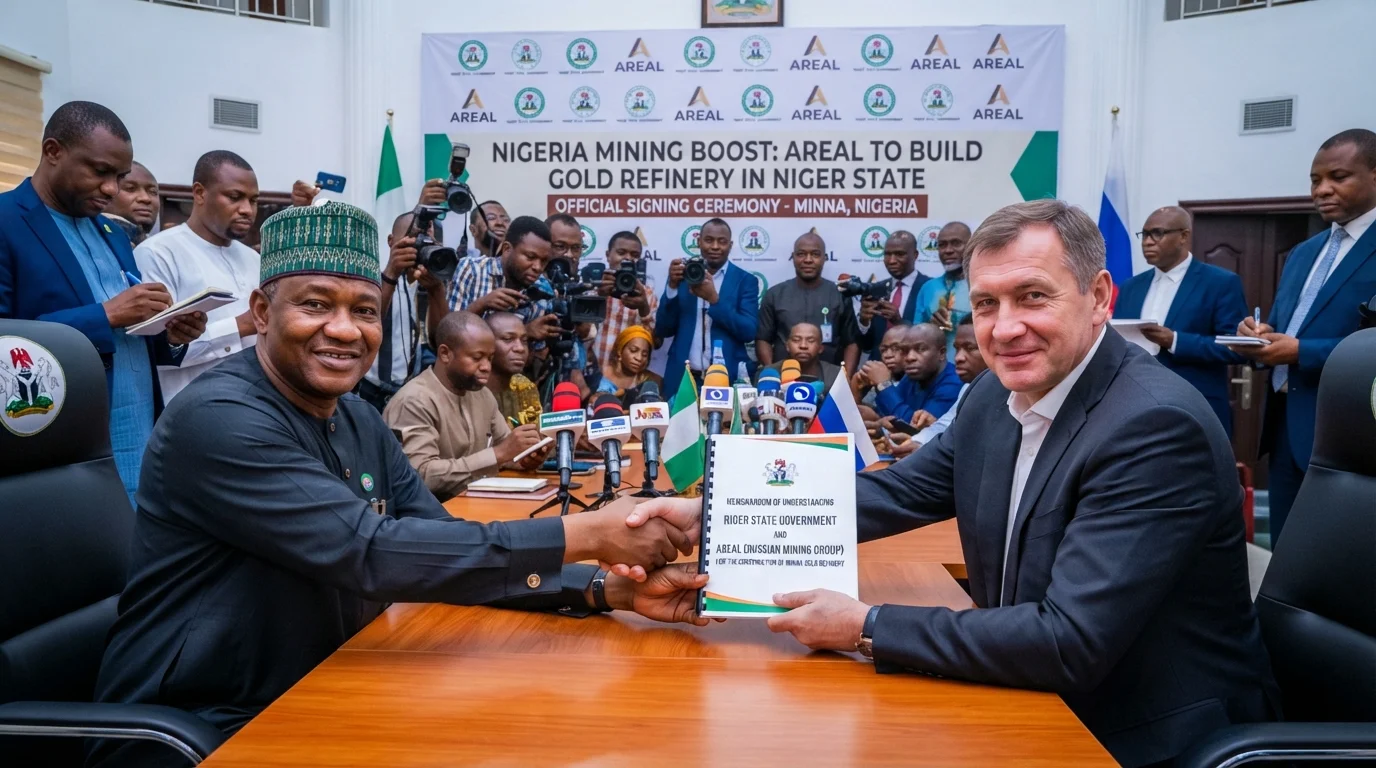
Nigeria Mining Boost: Russian Company Areal to Build Gold Refinery in Niger State
- November 24, 2026
- 6
- Business
MINNA, Nigeria — The Niger State government has signed an agreement with Russian mining company Areal to construct a gold refining plant in Minna, the state capital. Announced by the Russian Trade Representation in Nigeria on November 2, 2026, the partnership represents a major push by sub-national authorities to expand domestic mineral processing, formalize artisanal gold trade, and diversify state revenue away from federal oil allocations.
For Nigeriawide.com readers tracking Nigeria’s solid minerals transformation, industrial policy, and foreign direct investment, the Minna refinery proposal highlights a pivotal shift in how resource-rich states approach mineral wealth. For decades, gold extracted across north-central Nigeria has left the country largely in raw or semi-processed form, surrendering high-margin refining revenues, employment, and tax receipts to foreign bullion hubs.
Strategic Significance of the Minna Gold Refinery Deal
Niger State sits along some of Nigeria’s most productive gold-bearing geological belts, with active deposits spanning local government areas such as Shiroro, Rafi, Paikoro, and the outskirts of Minna. Despite abundant reserves, the state’s gold economy has historically been dominated by informal, unrecorded extraction and cross-border smuggling networks.
Establishing a commercial gold refinery inside Minna is designed to reshape that value chain in three critical ways:
- Domestic Value Addition: By refining doré bars and raw gold locally into high-purity bullion, Niger State can retain industrial processing margins within Nigeria rather than exporting raw minerals at discounted prices.
- Revenue Formalization and Royalty Capture: A regulated refining hub provides a transparent off-take point where state and federal authorities can track production volumes, collect statutory royalties, and curb illicit revenue leakage.
- Industrial and Service-Sector Spillover: Beyond direct plant operations, commercial refining generates sustained demand across assaying laboratories, armored logistics, power infrastructure, equipment maintenance, construction, and legal and financial services.
Bilateral Context: Russia’s Expanding Footprint in Nigerian Solid Minerals
The agreement between Niger State and Areal was facilitated with the backing of the Russian Trade Representation in Nigeria. It builds upon broader diplomatic and economic frameworks between Moscow and Abuja, including the Russia–Nigeria Intergovernmental Commission on Trade, Economic, Scientific, and Technical Cooperation.
Across West Africa and the Sahel, Russian industrial and mining firms have increasingly positioned mineral processing, geological exploration, and infrastructure development at the center of their economic engagement. For Nigerian policymakers, attracting foreign technical partners capable of financing and operating downstream mineral processing plants aligns directly with the Federal Government’s broader solid minerals reform agenda—which emphasizes local beneficiation over raw commodity exports.
Integrating Artisanal Miners into a Safe, Legal Supply Chain
A central question surrounding any commercial refinery in north-central Nigeria is feedstock security. Federal mining officials estimate that over 90 percent of Nigeria’s gold extraction is carried out by artisanal and small-scale miners. Without an organized mechanism to bring these operators into the formal market, a local refinery risks either underutilization or exposure to untraceable supply chains.
Formalizing Niger State’s artisanal sector into structured cooperatives offers a practical bridge between rural diggers and the proposed Areal plant:
- Cooperative Registration and Mineral Titles: Under the Nigerian Minerals and Mining Act (NMMA) 2007, registered cooperatives can obtain Small-Scale Mining Leases (SSMLs) or enter tributary agreements on existing leases, giving miners legal standing to extract and sell ore.
- Mercury-Free Processing Hubs: Centralized washing and gravimetric concentration centers eliminate toxic mercury runoff into community streams while improving gold recovery rates for local miners.
- Transparent Buying Centers: Equipped with X-ray fluorescence (XRF) analyzers and calibrated scales, licensed buying centers near mining clusters can offer instant digital payouts pegged to international spot prices—undercutting informal middlemen and smugglers.
- Chain-of-Custody Traceability: Biometric miner registration and batch logging from licensed sites to the refinery gate ensure conflict-free, environmentally compliant bullion suitable for sale to the Central Bank of Nigeria (CBN) and international buyers.
Addressing Governance, Safety, and Community Pressures
The push to formalize Niger State’s gold sector comes at a moment of heightened public scrutiny over mining governance and human safety. In September 2026, the deaths of 37 detained suspected illegal miners in Minna sparked widespread protests and prompted Senate motions demanding accountability and institutional reform. Meanwhile, host communities across mining corridors have repeatedly raised concerns over unreclaimed open pits, farmland encroachment, water contamination, and insecurity linked to criminal turf disputes.
Industry analysts emphasize that pairing industrial investment with cooperative formalization and strict environmental enforcement is essential to breaking the cycle of punitive crackdowns and informal proliferation. When miners have legal pathways to sell gold safely at fair market prices, communities gain economic stability while authorities gain regulatory visibility.
Key Milestones to Watch Before Groundbreaking
While the signing of the agreement signals strong bilateral intent, mining sector observers caution that formal pacts represent the initial stage of project delivery rather than immediate construction. Moving from agreement to commercial operations in Minna will depend on several concrete benchmarks:
| Execution Benchmark | Key Questions for Stakeholders | Why It Matters |
| Feasibility & Financing | What is the total capital commitment, funding structure, and projected annual refining capacity? | Determines project bankability and realistic commissioning timelines. |
| Regulatory Approvals | When will federal mining licenses, Environmental Impact Assessments, and operational permits be secured? | Ensures full compliance with federal solid minerals and environmental laws. |
| Equity & Fiscal Terms | What ownership stake, royalty sharing, and tax arrangements govern the partnership? | Defines long-term financial returns and public accountability for Niger State. |
| Infrastructure & Security | How will reliable industrial power, transport corridors, and site security be guaranteed? | Protects continuous plant operations and investor confidence in the region. |
Outlook for Niger State’s Industrial Ambitions
If backed by transparent governance, binding investment timelines, and inclusive artisanal supply chains, the proposed Areal gold refinery could position Minna as a premier precious-metals processing hub in West Africa. For Niger State, the agreement offers a tangible opportunity to convert natural geological endowments into sustainable industrial jobs, stronger internally generated revenue, and safer mining communities. Over the coming months, investors, regulators, and residents alike will be watching closely for feasibility milestones and groundwork that turn diplomatic momentum into steel and concrete on the ground.


Add Comment