
Nigerian Coal Explained: Reserves, High-Thermal Uses, and Energy Transition Reality
- November 21, 2026
- 13
- Business
Long before crude oil became the main driver of national revenue, coal was the foundation of energy and transit in early twentieth-century Nigeria. Discovered in Enugu in 1909, commercial mining began in 1916 and powered national railway networks, maritime fleets, and regional thermal power stations for decades.
However, the discovery of commercial crude oil in Oloibiri in 1956, coupled with the disruptions of the Nigerian Civil War, led to the decline of state-run mining operations. The infrastructure fell into disuse, and the industry stagnated.
Today, as Nigeria faces severe grid power challenges alongside global pressure to decarbonize, Nigerian coal presents an intriguing economic dynamic. It is a high-grade, underutilized thermal asset capable of bridging domestic power gaps and reducing energy costs for heavy industrial manufacturing.
Geological Formation and Proven Reserves
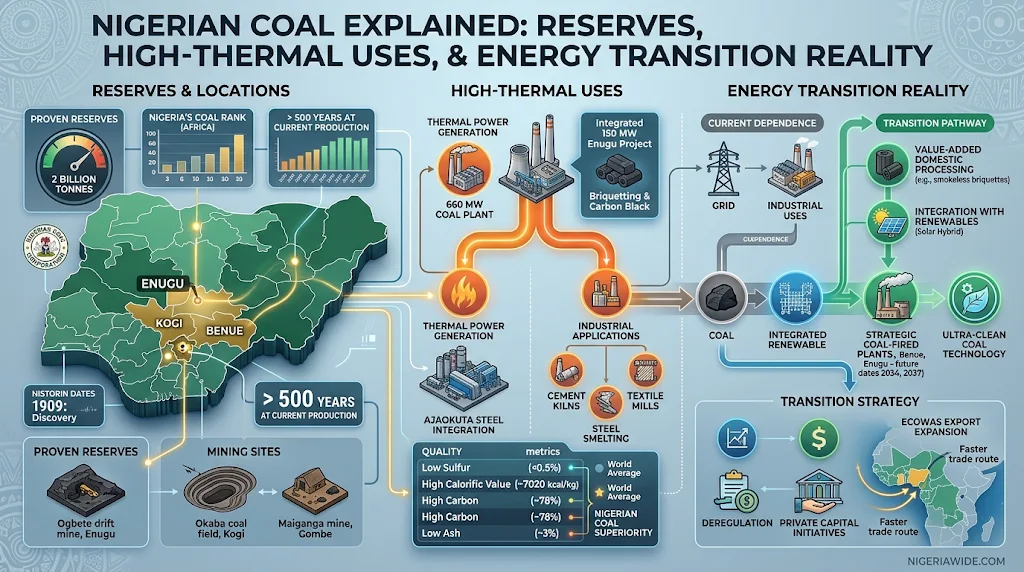
Nigeria holds substantial coal deposits spread across the Benue Trough sedimentary basin. The country’s proven reserves are estimated at over 600 million metric tonnes, with total geological deposits reaching up to 3 billion tonnes across more than 13 states.
Unlike many international deposits that contain high levels of impurities, Nigerian coal is globally recognized for its environmental and thermal advantages:
- Low Sulfur Content: Typically measuring below 0.5 percent to 1 percent, which significantly minimizes sulfur dioxide emissions during combustion.
- Low Ash and Moisture: Yields higher thermal combustion efficiency with reduced solid ash waste residue.
- High Bituminous Value: Sub-bituminous to bituminous grades offer high calorific value, making it effective for industrial heat generation and captive power plants.
Key Mining Belts Across Nigeria
- Enugu State: The historical center of Nigerian coal, featuring long-established underground and surface mines at Okpara, Iva Valley, and Onyeama, alongside strategic thermal hubs like Oji River.
- Kogi and Benue States: Home to extensive sub-bituminous fields around Okaba, Ogboyaga, and Ezimo, which feed heavy industrial plants in the North-Central region.
- Nasarawa, Gombe, and Plateau States: Feature promising deposits of coking coal and high-thermal seams suitable for specialized metallurgical applications.
- Southern Lignite Belts: Lignite (brown coal) deposits extend across Ondo, Edo, Anambra, and Delta states, representing a lower-density thermal reserve suitable for localized gasification and chemical synthesis.
High-Thermal Uses and Industrial Utility
While global energy debates often focus exclusively on utility-scale grid power, the most immediate economic value of Nigerian coal lies in off-grid industrial heat and heavy manufacturing applications.
1. Captive Power Generation for Heavy Manufacturing
Relying on the national electricity grid remains a major challenge for heavy industrial operations in Nigeria. Operating heavy industrial machinery solely on diesel or low-pour fuel oil (LPFO) generators incurs high operational costs that eat into corporate margins.
Bituminous coal provides a reliable, cost-effective alternative for captive thermal power plants. Manufacturing hubs, steel rolling mills, and processing plants across the Middle Belt and Southern regions utilize coal-fired boilers to maintain uninterrupted production cycles.
2. Cement Manufacturing and Kiln Heating
Cement production is one of Nigeria’s most successful industrial sectors. Producing Portland cement requires heating rotary kilns to temperatures exceeding 1,400 degrees Celsius to convert limestone and clay into clinker.
Using low-sulfur coal as a primary or supplementary fuel in cement kilns significantly lowers energy expenditure per bag of cement. Additionally, coal combustion ash (fly ash and bottom ash) serves as a valuable industrial input, blended directly into cement formulations to improve concrete durability and structural integrity.
3. Steel Production and Metallurgical Smelting
Integrated steel complexes require high-carbon thermal agents to reduce iron ore into pig iron and structural steel. Specialized coking coal reserves found in parts of Kogi and Nasarawa states offer essential feedstocks for domestic blast furnaces, direct reduced iron (DRI) processes, and localized metal foundries.
4. Industrial Heat for Tiles, Ceramics, and Chemicals
From commercial tile manufacturing plants in Ogun and Kogi states to chemical processing facilities in the East, coal provides the sustained high-temperature thermal energy required for large-scale drying kilns, steam generation, and industrial chemical synthesis.
The Energy Transition Reality: Balancing Power Needs and Decarbonization
The debate surrounding Nigerian coal highlights the challenge of balancing domestic industrial growth with global climate commitments.
Global Climate Commitments vs. Local Energy Realities
Under its Energy Transition Plan (ETP), Nigeria has committed to reaching net-zero carbon emissions by 2060. International climate frameworks and global multilateral lenders have largely restricted funding for new coal-fired power infrastructure, encouraging a shift toward natural gas, solar, and hydro energy.
However, domestic energy demands present a practical counter-perspective:
- Energy Poverty: Millions of Nigerian households and businesses lack reliable grid electricity, creating a strong practical argument for utilizing all available domestic energy sources.
- Industrial Base Creation: Western and Asian economies historically built their industrial foundations on low-cost coal power. Expecting developing nations to completely bypass abundant, low-cost domestic minerals before establishing basic industrial self-sufficiency remains a point of contention in international policy discussions.
- Sub-Bituminous Purity: Because Nigerian coal features low sulfur content, its localized carbon footprint and atmospheric pollutant load are lower than the heavy low-grade coal utilized in larger global economies.
Modern State-Led Off-Grid Power Initiatives
Rather than relying on large national grid projects, modern coal utilization in Nigeria is shifting toward state-level industrial initiatives.
Sub-national governments, particularly in Enugu State, are advancing solid mineral reforms to license private operators for captive power plants. Establishing localized, pit-head power stations—such as proposed developments in the Oji River basin—allows states to generate dedicated 300MW to 600MW industrial power hubs to supply nearby manufacturing clusters directly, bypassing national grid transmission constraints.
The Path Forward for Nigerian Coal
Unlocking the economic value of Nigeria’s coal reserves while managing environmental responsibilities requires targeted operational priorities:
- Adopting Clean Coal Technologies: Implementing high-efficiency, low-emissions (HELE) combustion systems, advanced electrostatic precipitators, and flue-gas desulfurization equipment to minimize localized particulate matter and greenhouse gas emissions.
- Developing Industrial Clusters: Positioning private coal mining licenses and power generation hubs directly adjacent to industrial zones, cement factories, and raw mineral deposits to reduce transportation costs.
- Encouraging Private Investment: Transitioning away from old state-monopoly models by maintaining clear, transparent regulatory frameworks under the Nigerian Minerals and Mining Act to attract technical mining operators.
- Integrating Biomass and Waste Blending: Exploring co-firing techniques that blend high-thermal coal with agricultural waste or biomass to gradually lower total industrial carbon intensity while preserving reliable base-load energy supply.
Nigerian coal represents a major, underutilized energy asset. By utilizing modern clean-combustion technology to meet heavy industrial power needs, Nigeria can leverage its vast coal reserves to drive domestic manufacturing, reduce industrial power costs, and support broader economic growth.
Hub Guide: This article is part of our comprehensive resource series on Nigeriawide.com. Read our central analysis on the Top 10 Most Valuable Natural Resources in Nigeria to explore state-by-state mineral maps, investment frameworks, and industrial asset reports.
Explore Nigeria’s Coal Mining Regions on Nigeriawide
Renewed industrial demand for reliable thermal energy and domestic solid fuels is bringing fresh attention to Nigeria’s coal belt—spanning Enugu, Kogi, and Benue states—turning historic mining districts into active destinations for energy investors, cement manufacturers, and geological consultants. Because major sub-bituminous seams around Enugu’s Onyeama and Okpara fields, Kogi’s Okaba and Ogboyoga belts, and Benue’s Owukpa deposits extend across semi-rural terrain, executing a productive site visit requires careful travel planning from the outset.
Whether you are coordinating an international energy delegation or conducting an interstate quarry and mine assessment, streamlining your transit is the essential first step. Coal corridors across the Anambra Basin are most efficiently accessed by flying into Akanu Ibiam International Airport in Enugu before continuing overland to nearby sites in Kogi and Benue. You can instantly compare domestic flight schedules and secure your corporate transit through the Nigeriawide Flight Booking Portal for a seamless arrival.
Once your travel dates are confirmed, use the Nigeriawide Discovery Guide to organize the rest of your itinerary. Our verified destination maps connect you directly to secure business-class hotels in Enugu and Makurdi, top-rated restaurants for corporate dinners, and dependable 4×4 car rental services built to navigate rugged mining terrain. Plan your trip with us to ensure your field operations across Nigeria remain safe, efficient, and productive.


Add Comment