
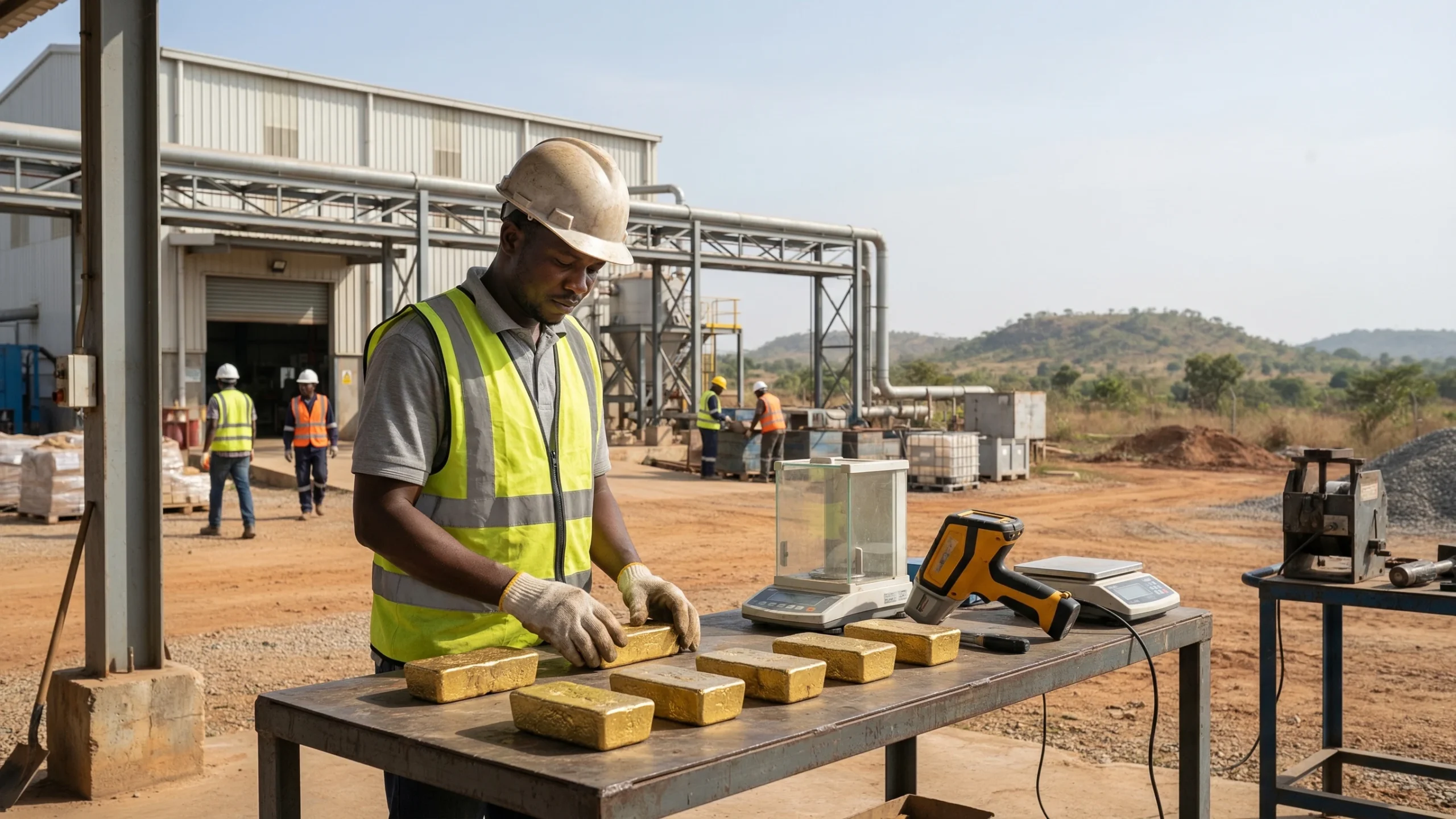
What Does the Niger State and Areal Gold Refinery Deal Mean for Nigeria’s Mining Sector?
- November 25, 2026
- 15
- Business
MINNA, Nigeria — When the Russian Trade Representation in Nigeria announced in early November 2026 that Russian mining group Areal had signed an agreement with the Niger State government to build a gold refining plant in Minna, the news resonated well beyond north-central Nigeria. Coming alongside Niger State’s earlier June 2026 outreach to Australian partners for downstream gold processing, the agreement underscores a structural shift across Nigeria’s solid minerals landscape: sub-national governments and federal policymakers are moving decisively to end raw mineral exports and anchor industrial processing inside the country.
Related: Nigeria Mining Boost: Russian Company Areal to Build Gold Refinery in Niger State
As we track Nigerian business, economic policy, and infrastructure at Nigeriawide.com, the Niger State–Areal pact serves as an important case study in how Nigeria is trying to convert an estimated $700 billion in untapped solid mineral wealth—which currently contributes less than one percent to national Gross Domestic Product (GDP)—into measurable industrial output.
1. Enforcing Nigeria’s “No Raw Export” Value-Addition Mandate
At the federal level, the Ministry of Solid Minerals Development under Dr. Dele Alake has anchored its regulatory overhaul on a strict local beneficiation policy: mining operators are expected to establish domestic processing plants rather than shipping raw ore from pit to port. That policy shift has already helped lift annual federal solid minerals revenue six-fold from ₦6 billion to ₦38 billion while attracting over $800 million in fresh foreign direct investment, particularly in lithium processing across Nasarawa and Kogi states.
The Minna gold refinery agreement extends this value-addition doctrine directly into Nigeria’s gold belt. Historically, raw and semi-processed Nigerian gold has leaked across porous borders to foreign bullion hubs in the Middle East and Asia, depriving both Abuja and host states of refining margins, corporate taxes, and industrial jobs. By locating refining capacity in Minna—close to active gold corridors in Shiroro, Rafi, and Paikoro—the project aims to capture downstream processing value before any metal leaves Nigerian soil.
2. Supporting the Central Bank’s Domestic Gold Reserve Strategy
Beyond state-level internally generated revenue, expanded local refining directly reinforces Nigeria’s monetary policy. The Federal Government has prioritized purchasing locally mined gold in Naira through formal aggregation channels to bolster the Central Bank of Nigeria’s (CBN) foreign reserves without spending scarce US dollars on international bullion markets.
However, central banks and institutional buyers require bullion refined to strict international purity and chain-of-custody standards. A commercial refinery operating under regulated compliance frameworks in Minna can bridge the gap between raw doré bars extracted in north-central Nigeria and investment-grade gold suitable for sovereign reserve accumulation or certified export.
3. Catalyst for Formalizing Artisanal and Small-Scale Miners
Gold extraction in Nigeria remains overwhelmingly informal, with artisanal and small-scale miners accounting for the vast majority of domestic output. Without nearby, transparent buyers offering fair market prices, small-scale operators remain vulnerable to predatory middlemen, smuggler networks, and unsafe mercury-based washing practices.
A commercial refinery in Minna creates a powerful economic anchor to accelerate the Federal Government’s Artisanal and Small-Scale Mining (ASM) formalization drive and the Presidential Artisanal Gold Mining Development Initiative (PAGMI):
- Predictable Off-Take Demand: Registered mining cooperatives holding Small-Scale Mining Leases (SSMLs) gain a legitimate, high-volume buyer within their own state.
- Transparent Assaying and Pricing: Licensed buying centers connected to the refinery can test gold purity on-site and pay miners competitive Naira rates pegged to global benchmarks, undercutting illicit aggregators.
- Environmental and Safety Leverage: Conditioning refinery off-take on traceable, mercury-free extraction gives regulators practical market leverage to enforce safer mining practices and land reclamation.
4. Sub-National Agency Within a Federal Mining Framework
Constitutionally, solid minerals in Nigeria sit on the Exclusive Legislative List, meaning licensing, cadastre administration, and primary regulation rest with the Federal Government via the Nigerian Mining Cadastre Office (MCO) and the newly established Nigerian Solid Minerals Company (NSMC). Yet state governments bear the direct social, environmental, and security consequences of mining on their land.
Niger State’s proactive negotiation with Areal—backed by the Russian Trade Representation in Nigeria—demonstrates how state administrations can operate within federal law by acting as investment facilitators. By de-risking land access, coordinating host-community consent, and linking mineral processing to state logistics hubs such as the Baro Inland Port, state governments can attract foreign technical partners without overstepping federal licensing jurisdiction.
5. Geopolitical Diversification of Foreign Direct Investment
The partnership also reflects a broader diversification in Nigeria’s foreign investment sources. While Chinese firms have dominated recent lithium processing investments and Australian and British juniors have targeted exploration, Russia’s entry into downstream gold refining builds on the Russia–Nigeria Intergovernmental Commission on Trade, Economic, Scientific, and Technical Cooperation. For Nigeria, engaging multiple international partners strengthens competitive bargaining power and accelerates technology transfer in metallurgy and geological surveying.
Sectoral Impact at a Glance
| Sector Dimension | Pre-Refinery Status Quo | Potential Impact of the Minna Refinery Deal |
| Value Chain Position | Raw ore and doré exported informally with minimal local processing. | Domestic refining retains high-margin bullion processing inside Nigeria. |
| Monetary & Fiscal Policy | Heavy royalty leakage and limited certified bullion for CBN reserves. | Stronger state/federal tax capture and Naira-sourced gold for national reserves. |
| Artisanal Miners (ASM) | Dependent on informal middlemen, cash sponsors, and hazardous practices. | Structured cooperative off-take, fair spot-linked payouts, and formal certification. |
| Support Ecosystem | Undersupplied local assaying, haulage, and mining support services. | New demand for laboratories, armored logistics, power, and equipment suppliers. |
The Execution Test Ahead
Industry analysts emphasize that signing a bilateral agreement is only the starting line. Before Minna’s proposed refinery pours its first certified gold bar, stakeholders must complete bankable feasibility studies, finalize capital financing, secure federal environmental and operating licenses, and guarantee reliable power and corridor security.
If Niger State and Areal clear those operational hurdles with transparent governance and strong artisanal integration, the Minna refinery will stand as a watershed moment—proving that Nigeria’s solid minerals sector can move beyond raw extraction to become a disciplined, value-adding pillar of national economic diversification.



Add Comment