
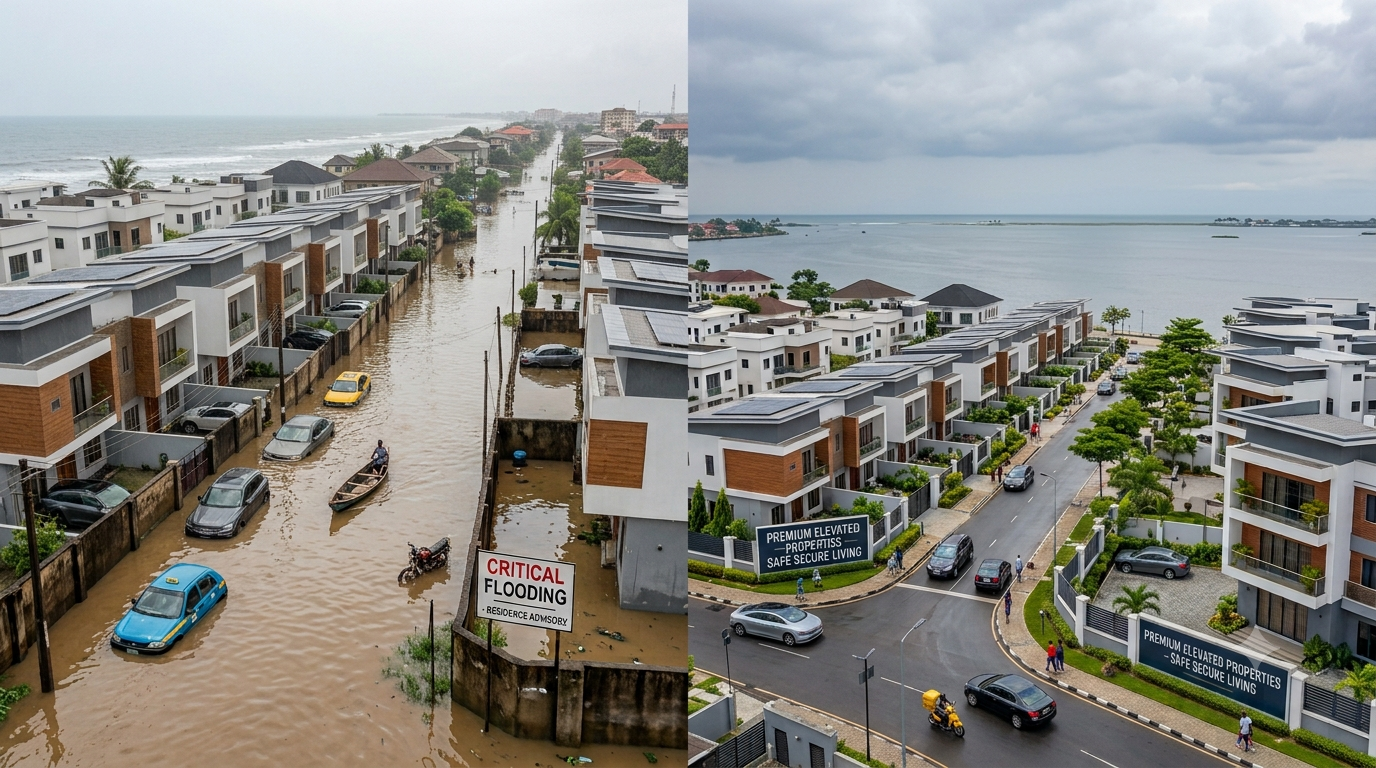
It is a familiar, heartbreaking scene. You scroll through Instagram and spot a gorgeous, newly built semi-detached duplex in a “fully serviced” estate around Lekki or Orchid Road. The facade is immaculate. The interior boasts pristine Spanish tiles, LED strip lighting, and a fitted kitchen. The developer’s brochure promises “uninterrupted luxury living.” You pay the deposit, sign the deed of assignment, and feel like a king.
Then, June arrives.
The heavy, relentless Atlantic rains descend on Lagos. Within forty-eight hours, that glittering estate gate becomes a harbor. The beautifully interlocked street is submerged in waist-deep, murky water. Residents are seen wading to work with their trousers rolled up, or worse, abandoning their flooded Mercedes-Benz sedans at the estate entrance.
Welcome to the “Dry Season Scam.” This is the unspoken rite of passage in the Lagos property market.
In January, when the sun is scorching and the ground is bone-dry, every plot of land in Lagos looks like prime, solid earth. Developers easily mask terrible drainage infrastructure and swampy foundations behind a layer of cheap interlocking stones and fresh paint. For diaspora buyers and unsuspecting local investors, buying property during this window is a multi-million Naira gamble.
If you want to protect your hard-earned capital from literally sinking into the Atlantic, you must learn to look past the dry-season aesthetics. Here is your definitive, BS-free guide to identifying and avoiding flood-prone coastal properties in Lagos.
The Anatomy of Lagos Coastal Flood Risks: Island vs. Mainland
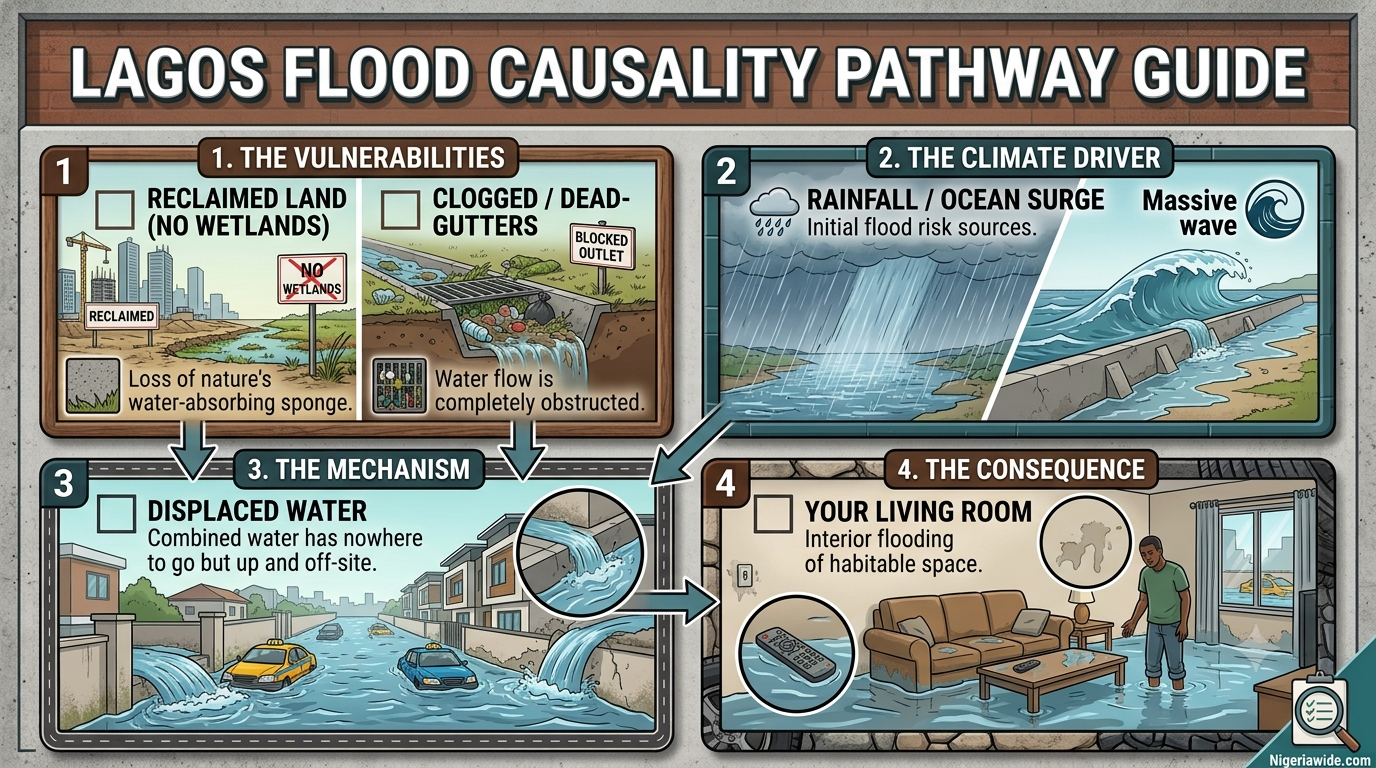
To make a smart investment, you must understand the topography of the city. Lagos is essentially a collection of islands, sandbars, and lagoons hugged by the Atlantic Ocean. As the population explodes, developers have aggressively reclaimed wetlands and swamps to meet the insatiable demand for real estate.
When you sand-fill a natural wetland, you don’t destroy the water; you merely displace it. Without massive, state-backed drainage infrastructure and ocean barriers, that water will always find its way back home.
High-Risk Coastal & Island Zones
The Lagos Island property market carries the highest risk of coastal flooding and sea-level rise due to its low elevation and aggressive reclamation projects.
- Lekki Phase 1 Lowlands: While the right side of Lekki Phase 1 (closer to the expressway) enjoys relatively decent elevation, the low-lying zones toward the lagoon side frequently experience severe flash flooding.
- The Orchid Road Axis & Lafiaji: This corridor has seen an unprecedented construction boom. Unfortunately, much of this area was originally deep mangrove swamp. The drainage networks here are highly fragmented, leading to chronic water pooling that lingers for days after a downpour.
- Agungi and Idado: These middle-income hubs suffer from a severe lack of central stormwater drainage. Individual estates channel water onto the main streets, creating mini-lakes every rainy season.
- Ibeju-Lekki Coastal Plains: While marketed as the “New Lagos,” certain pockets close to the coastal plane are highly vulnerable. Without a proper environmental impact assessment, buying cheap land here is incredibly risky.
Mainland Flood Points to Watch
Do not let Mainland sellers fool you; the mainland has its own hydrological nightmares. Mainland flooding is less about sea-level rise and more about poor urban planning, clogged canal systems, and outdated infrastructure.
- Gbagada (Certain Communities): Areas like Gbagada Phase 2 and Medina Estate are highly sought after. However, properties built close to the primary channels feeding into the Lagos Lagoon frequently experience backflow during peak tides.
- Oworonshoki and Bariga: Being directly on the edge of the lagoon, the lower-lying parts of these neighborhoods face significant waterlogging issues when the lagoon level rises.
- Surulere (Low-lying Hubs): Classic neighborhoods like Idi-Araba, parts of Adeniran Ogunsanya, and Aguda are notorious for flash flooding. The ancient drainage systems here simply cannot handle the volume of modern runoff.
How to Spot a Flood-Prone Property in the Dry Season
If you are shopping for property between November and March, you have to play detective. The seller will not tell you about the floods, and the freshly painted walls will try to hide it.
You must look for the physical clues that the environment leaves behind.
Read the Structural Clues
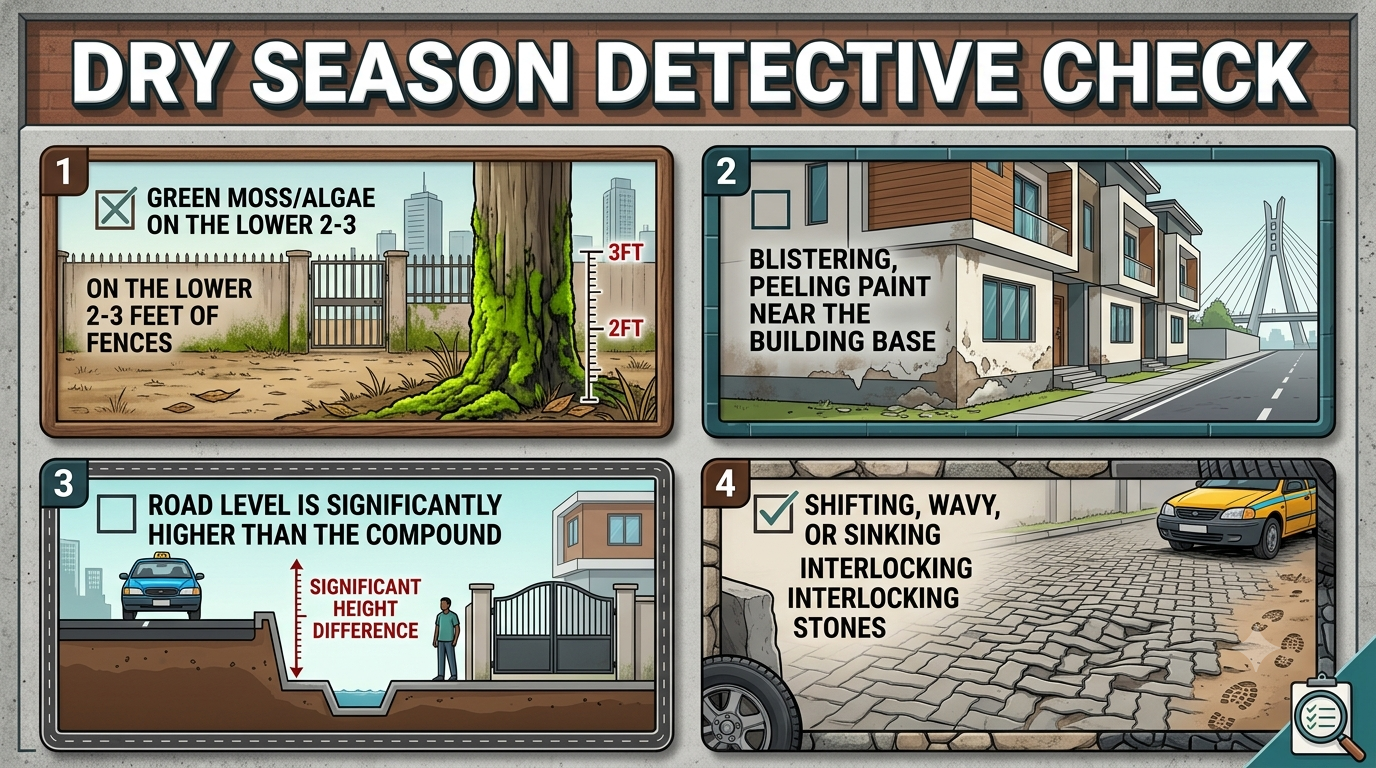
Water always leaves a footprint. Walk around the perimeter of the building and inspect the fences of neighboring properties.
Look closely for green moss or dark algae lines running horizontally along the lower two to three feet of the walls. This is a clear indicator of standing water levels from the previous rainy season.
Inspect the external plastering of the building. Do you see damp patches, bubbling paint, or white powdery deposits (efflorescence) near the base? This means the building lacks a proper Damp Proof Course (DPC) membrane, and groundwater is actively being sucked up into the walls, compromising the structural integrity of the home.
Analyze the Street Topography
Stand on the street and look at the slope.
Is the road higher than the compound’s foundation? In Lagos, roads are frequently resurfaced by laying new asphalt or interlocking stones directly over the old ones, raising the street level.
If the compound sits lower than the street, that property will act as a retention basin for all the runoff from the road during a heavy downpour. You want a property where the finished floor level of the ground floor is elevated at least three to four feet above the crown of the adjoining road.
The Interlocking Stones Check
Many developers lay interlocking tiles directly over poorly compacted, waterlogged soil to quickly make a compound look clean and dry.
Walk slowly across the compound. Look for uneven, sinking, or “wavy” sections of the tiles. If you step on certain areas and feel a slight squish or notice that tiles are dipping, the soil underneath is highly saturated and poorly compacted. Over time, this shifting earth will cause severe foundation cracks.
The Remote Investor’s Toolkit: Verifying Property from Abroad
As a diaspora buyer, you are the prime target for unscrupulous developers. You cannot physically walk the land, and polished drone videos taken on a sunny day in January can easily mislead you.
To protect your real estate portfolio, you must deploy a rigorous verification protocol.
1. Demand the “Rainy Day” Video Proof
Never buy a property based on archive photos. If you are negotiating during the rainy season (May to September), instruct your representative to visit the site during or immediately after a heavy downpour.
Have them conduct a live, unedited video call. They should walk the entire street, showing you the state of the drainage channels, the water level in the compound, and how the neighboring streets are coping. If the agent makes excuses about why they cannot visit on a rainy day, walk away from the deal.
2. Leverage Google Earth Historical Imagery
You do not need to be in Lagos to study the land’s history. Download Google Earth Pro on your desktop. Enter the property’s coordinates and use the historical imagery slider to travel back 5 to 10 years.
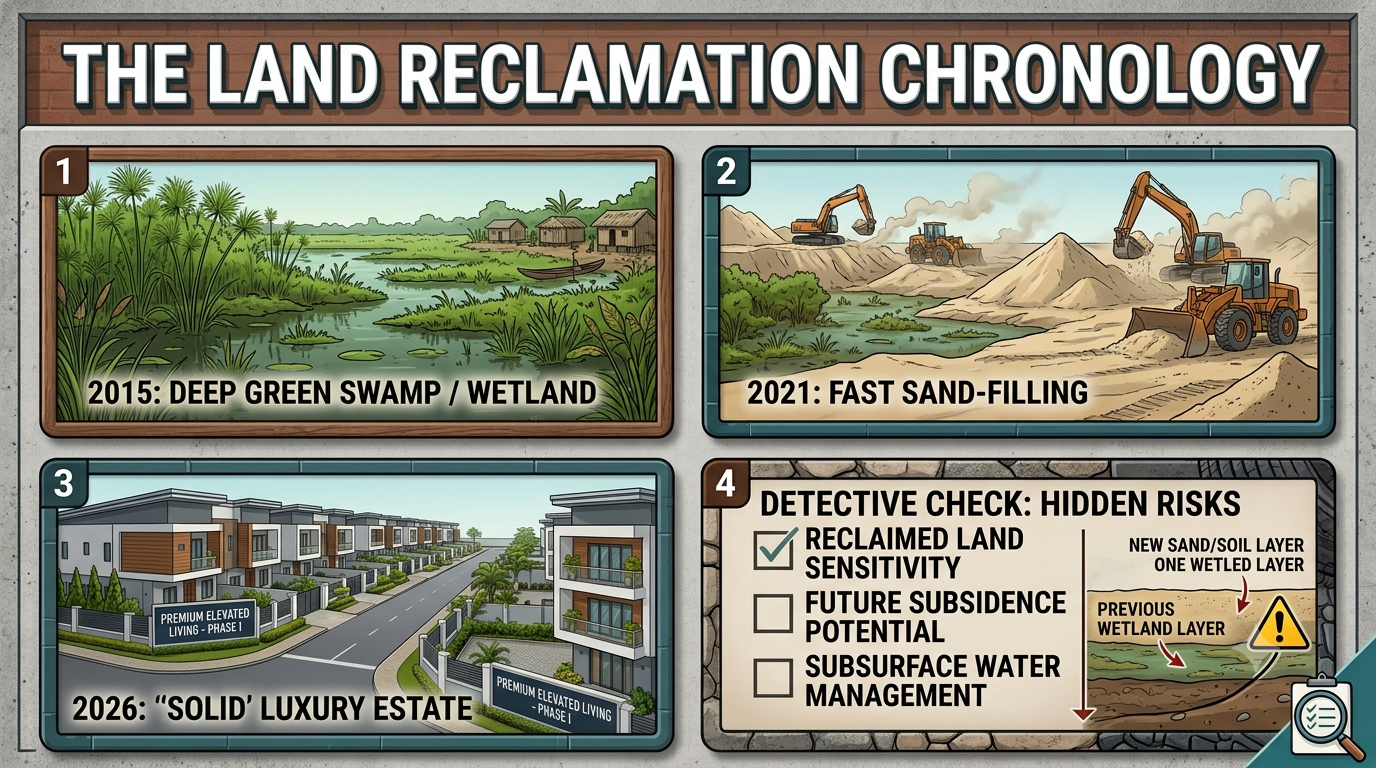
If the satellite imagery shows that the plot was a bright green wetland, a retention pond, or a river path a few years ago, you are looking at a reclaimed swamp. Reclaimed land requires incredibly deep, expensive piling foundations. If the developer only used a simple raft foundation on this soil, the building is highly susceptible to sinking and structural failure.
3. Hire an Independent Surveyor
Do not rely on the surveyor or agent provided by the developer. Hire your own independent, registered surveyor to visit the site.
Instruct them to take precise elevation readings relative to the nearest body of water and inspect the local topography. Ask them to confirm if the land falls within a designated flood plain on the Lagos State master plan. Paying a professional fee now will save you tens of millions of Naira in future property damage.
Summary Checklist: The “Dry Land” Buying Protocol
Before you sign any search report or make a commitment on a Lagos property, run through this strict buying protocol.
- Check the Foundation Elevation: Is the ground floor slab at least 1 meter (3.2 feet) above the drainage level?
- Trace the Drainage Flow: Follow the compound’s gutters. Do they connect to a functional, free-flowing primary neighborhood canal? Or do they empty into a dead-end ditch that will overflow back into the compound?
- Interview the Locals: Do not just talk to the smooth-talking sales rep. Walk down the street and chat with the local kiosk owners, the neighborhood mallams, or security guards who have lived there for years. Ask them a simple question: “How high does the water get here in July?” Their answers will save you from making a catastrophic investment.
- Verify the Soil Test and Title Documents: Ask the developer for the certified soil test report. For high-rise or heavy structures on coastal land, ensure they used piled foundations rather than cheap strip or standard raft foundations. Ensure the land has a valid Certificate of Occupancy (C of O) or Governor’s Consent that matches the registered layout.
Navigate the Lagos Market with Confidence
Buying real estate in Lagos can yield spectacular, wealth-generating returns—but only if your asset remains safely above water. By treating every dry-season listing with healthy skepticism, asking the hard questions, and refusing to rely solely on glossy brochures, you can build a highly resilient, highly profitable property portfolio in Nigeria’s commercial capital.
If you are ready to eliminate the guesswork and invest with peace of mind, let us connect you with developers who build to strict environmental standards. Click here to Discover verified real estate developers in Nigeria and explore our curated directory of vetted real estate companies in Nigeria.



Add Comment