
- November 11, 2026
- 7
- Business
Nigeria is often described as a land blessed with extraordinary natural wealth. While petroleum and crude oil have dominated the national revenue conversation for over five decades, the nation’s geological landscape holds over 44 distinct mineral resources distributed across its 36 states and the Federal Capital Territory.
Beyond fossil fuels, Nigeria possesses vast reserves of industrial minerals, critical energy transition metals, and rich agricultural resources capable of powering domestic manufacturing, infrastructure expansion, and regional economic stability.
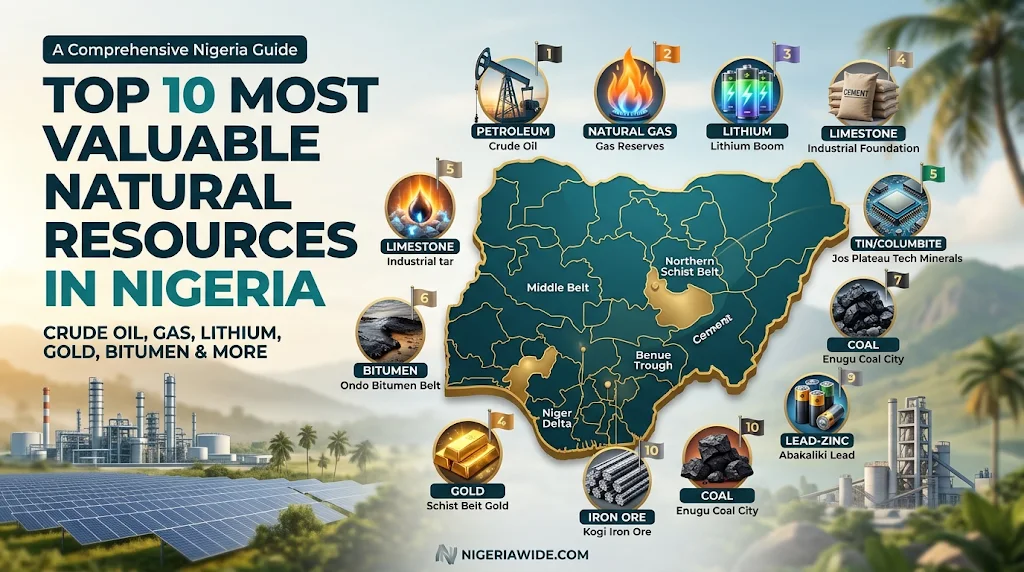
This comprehensive guide breaks down the 10 most valuable natural resources in Nigeria, detailing their geological locations, economic applications, commercial potential, and current operational landscape.
The Natural Resource Landscape in Nigeria
Nigeria’s natural wealth is broadly categorized into liquid hydrocarbons, solid minerals, and agricultural raw materials. The country’s geological foundation is split into two major formations:
- Sedimentary Basins: Found across the Niger Delta, Anambra, Benue Trough, Chad Basin, and Sokoto Basin—hosting petroleum, natural gas, limestone, coal, bitumen, and gypsum.
- Basement Complex and Younger Granite Complexes: Dominating the Middle Belt, Southwest, and Northern regions—hosting gold, lithium, iron ore, tin, columbite, lead-zinc, and precious gemstones.
While the Petroleum Industry Act (PIA) governs oil and gas extraction, the Nigerian Minerals and Mining Act regulates solid minerals, with recent policy shifts prioritizing domestic processing and value addition over the export of raw ores.
Top 10 Most Valuable Natural Resources in Nigeria
Selecting Nigeria’s most valuable resources requires assessing proven reserves, export revenue generation, local industrial utility, and global market demand.
1. Petroleum (Crude Oil)
Crude oil remains Nigeria’s largest revenue driver and foreign exchange earner. First commercially discovered at Oloibiri, Bayelsa State, in 1956, Nigeria holds Africa’s second-largest proven crude oil reserves, estimated at over 37 billion barrels.
- Primary Locations: Delta, Bayelsa, Rivers, Akwa Ibom, Imo, Abia, Edo, Ondo, and deepwater offshore fields in the Gulf of Guinea.
- Industrial and Economic Uses: Export revenue, petrol (PMS), diesel (AGO), aviation fuel, lubricants, heavy bitumen, and petrochemical feedstocks.
- Key Strategic Insight: With domestic refining platforms expanding—led by the Dangote Refinery alongside state-owned refinery rehabilitation efforts—Nigeria is shifting from exporting raw crude to serving as a regional hub for refined petroleum products.
2. Natural Gas
Nigeria is frequently described as a natural gas province with a pocket of oil. The country boasts Africa’s largest proven natural gas reserves, exceeding 200 trillion cubic feet (TCF), ranking among the top 10 largest reserves globally.
- Primary Locations: Niger Delta basin (onshore and offshore fields across Rivers, Delta, Bayelsa, and Akwa Ibom states).
- Industrial and Economic Uses: Power generation, Liquefied Natural Gas (LNG) exports, industrial thermal energy, compressed natural gas (CNG) for transit, and feedstock for chemical fertilizer production.
- Key Strategic Insight: Under the federal “Decade of Gas” initiative and major projects like the Ajaokuta-Kaduna-Kano (AKK) gas pipeline, natural gas is positioned as Nigeria’s primary transition fuel to power local industries and reduce reliance on expensive liquid fuels.
3. Lithium
Lithium has emerged as one of Nigeria’s most strategically valuable solid minerals due to the accelerating global demand for electric vehicle (EV) batteries, solar storage units, and consumer electronics.
- Primary Locations: Nasarawa, Kwara, Kogi, Kebbi, Zamfara, Ekiti, and Oyo states.
- Industrial and Economic Uses: Lithium-ion battery cathodes, energy storage systems, glass, ceramics, and specialized industrial lubricants.
- Key Strategic Insight: Nasarawa State has become the epicentre of Nigeria’s lithium boom, attracting major processing facilities. Government mandates now prohibit the export of raw lithium ore, requiring foreign and domestic investors to set up local processing plants to produce battery-grade lithium concentrate.
Deep Dive: Uncover state-level mining developments in The Ultimate Guide to Lithium Mining in Nigeria: Locations, Grades, and Ores.
4. Limestone
While crude oil drives exports, limestone is quietly the most industrially utilized solid mineral in Nigeria. Proven deposits run into billions of metric tonnes, forming the structural backbone of the national building and civil infrastructure sector.
- Primary Locations: Ogun, Kogi, Cross River, Benue, Sokoto, Gombe, Edo, and Enugu states.
- Industrial and Economic Uses: Portland cement manufacturing, quicklime, agricultural lime for soil neutralization, glass making, and fluxing agents in steel smelting.
- Key Strategic Insight: Large-scale extraction by industrial giants like Dangote Cement, BUA Cement, and Lafarge Africa has made Nigeria self-sufficient in cement production, turning the country into a net exporter across West Africa.
5. Bitumen (Tar Sands)
Nigeria holds one of the largest deposits of natural bitumen in the world, with estimated reserves exceeding 42 billion barrels. Despite its enormous volume, it remains one of the country’s most under-exploited natural assets.
- Primary Locations: Ondo, Ogun, Lagos, and Edo states (spanning a continuous belt of approximately 120 kilometers).
- Industrial and Economic Uses: Road asphalt surfacing, waterproofing membranes, heavy industrial fuel oil, and synthetic crude oil distillation.
- Key Strategic Insight: Nigeria currently spends millions of dollars importing asphalt for road construction. Full commercial exploitation of the Ondo-Ogun bitumen belt would satisfy domestic infrastructure demands and conserve significant foreign exchange.
6. Gold
Nigeria possesses vast reserves of high-grade alluvial and primary gold, concentrated within the geological Schist Belts of the Middle Belt, Northwest, and Southwest regions.
- Primary Locations: Zamfara, Osun, Kebbi, Niger, Kaduna, Kogi, Oyo, and Ebonyi states, as well as the Federal Capital Territory (FCT).
- Industrial and Economic Uses: Central Bank bullion reserves, jewelry, financial investment products, specialized electronics, and dental metallurgy.
- Key Strategic Insight: Formalization initiatives like the Presidential Artisanal Gold Mining Development Initiative (PAGMI) and Segilola Gold Project in Osun State (Nigeria’s first commercial-scale gold mine) demonstrate a shift from informal panning to structured, institutional mining.
7. Iron Ore
Iron ore reserves in Nigeria are estimated at over 3 billion metric tonnes. It is the primary raw material needed to support a fully integrated national steel and industrial equipment manufacturing industry.
- Primary Locations: Kogi State (notably the Itakpe deposits), Kaduna, Enugu, Niger, Zamfara, and Benue states.
- Industrial and Economic Uses: Steel manufacturing, construction rebar, automotive parts, heavy machinery fabrication, and industrial tools.
- Key Strategic Insight: The revival of the Itakpe Iron Ore Mining Company and its strategic link to the Ajaokuta Steel Complex remain central to reducing Nigeria’s heavy reliance on imported structural steel products.
8. Coal and Lignite
Historically mined since 1915 to power national railways and thermal plants, Nigerian coal is recognized globally for its low sulfur, low ash content, and high calorific value. Proven reserves stand at over 600 million tonnes, with indicated reserves nearing 3 billion tonnes.
- Primary Locations: Enugu (“The Coal City”), Kogi, Benue, Nasarawa, Gombe, Ondo, and Delta (lignite) states.
- Industrial and Economic Uses: Industrial heat generation for cement kilns, captive thermal power generation, smokeless fuel briquettes, and chemical manufacturing.
- Key Strategic Insight: As global energy grids balance transition timelines, low-sulfur Nigerian coal offers a dependable thermal energy source for heavy industrial processes, particularly in cement and manufacturing plants operating off-grid.
9. Lead-Zinc Ores
Lead and zinc naturally occur together within the Benue Trough sedimentary system. Nigeria’s proven lead-zinc reserves are estimated at over 10 million metric tonnes spread across central and eastern regions.
- Primary Locations: Ebonyi (Abakaliki), Benue, Nasarawa, Cross River, Plateau, Taraba, and Federal Capital Territory.
- Industrial and Economic Uses: Battery manufacturing (lead-acid), steel galvanization against corrosion, radiation shielding, brass alloys, and chemical pigments.
- Key Strategic Insight: High global demand for galvanized steel in construction and lead-acid storage batteries makes Nigerian lead-zinc deposits prime targets for commercial extraction and localized processing hubs.
10. Tin and Columbite
Nigeria has a long mining history with tin and columbite, particularly during the early to mid-20th century when the Jos Plateau was one of the world’s leading supply hubs. Columbite occurs alongside cassiterite (tin ore) and contains niobium and tantalum.
- Primary Locations: Plateau (Jos), Nasarawa, Kaduna, Bauchi, Kwara, and Kano states.
- Industrial and Economic Uses: Electronic solders, tinplate packaging, heat-resistant superalloys for aerospace engineering, capacitors, and micro-electronics.
- Key Strategic Insight: With the rise of advanced consumer technology, defense manufacturing, and microchips, high-purity Nigerian columbite and tin remain essential inputs for global high-tech supply chains.
State-by-State Natural Resource Highlights
To understand how resource wealth is spread across the geopolitical zones, here is a breakdown of key minerals found across selected states:
- Niger Delta (Delta, Rivers, Bayelsa, Akwa Ibom): Crude oil, natural gas, silica sand, bentonite clay.
- North-Central (Kogi, Nasarawa, Benue, Plateau, Kwara, Niger): Iron ore, lithium, limestone, coal, barite, tin, columbite, marble, gold.
- North-West (Zamfara, Kebbi, Kaduna, Sokoto): Gold, lithium, iron ore, limestone, kaolin, nickel.
- North-East (Gombe, Bauchi, Taraba, Borno, Adamawa): Gypsum, limestone, coal, barite, gemstones, uranium, diatomite.
- South-West (Ogun, Ondo, Osun, Oyo, Ekiti, Lagos): Bitumen, limestone, gold, lithium, marble, feldspar, glass sand.
- South-East (Enugu, Ebonyi, Anambra, Abia, Imo): Coal, lead-zinc, limestone, natural gas, rock salt, clay.
Unlocking Nigeria’s Natural Wealth: Strategic Priorities
Unlocking the full value of Nigeria’s natural resources requires overcoming several structural challenges:
- Local Value Addition: Transitioning from exporting raw, unprocessed minerals to setting up domestic processing plants, smelters, and refineries to capture full economic value and create employment.
- Infrastructure Development: Expanding heavy rail networks, power generation, and port facilities to connect interior mining sites in the Middle Belt and North directly to domestic factories and export terminals.
- Formalizing Artisanal Mining: Converting informal, small-scale mining operations into structured cooperatives with access to safer equipment, environmental regulation, and formal banking channels.
- Enforcing Environmental Standards: Implementing land reclamation policies and strict environmental safeguards across oil-producing regions and solid mineral mining sites to protect local ecosystems and agrarian communities.


Add Comment