
- November 8, 2026
- 14
- Entertainment
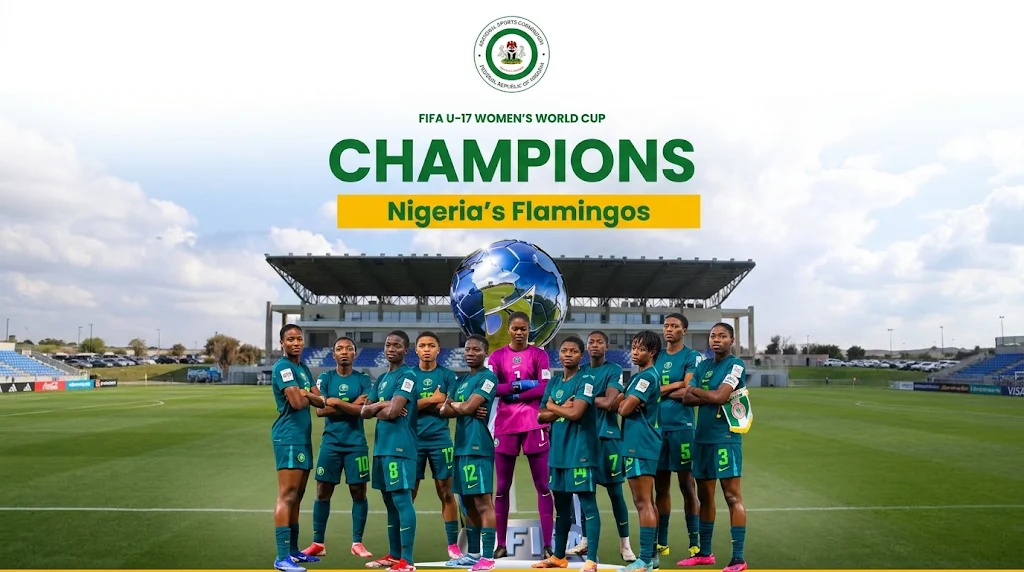
In a defining moment for international sport, Nigeria under 17 women national team, affectionately known as the Flamingos, achieved global glory by winning the FIFA U 17 Women World Cup. In a thrilling final staged in Rabat, Morocco, the Nigerian youngsters delivered a tactical masterclass to defeat Asian powerhouses Japan two goals to one.
The victory signifies far more than just a trophy addition. By reaching the summit of global youth football, the Flamingos officially became the first African team in history to win the FIFA U 17 Women World Cup. Furthermore, FIFA President Gianni Infantino confirmed that the triumph marks the first time any African women team has lifted a FIFA world trophy at any age tier.
Driven by tactical discipline, relentless physical energy, and remarkable mental resilience, coach Akeem Busari squad achieved what no African female team had accomplished before, rewriting the global football narrative.
From Stumble to Glory: The Path to the Crown
Great stories are rarely written without early heartbreak, and the Flamingos tournament journey read like a Hollywood script.
Nigeria campaign began in chilling fashion with a sharp two to one loss against a tactical Poland side. In short-format international tournaments, an opening day defeat is often a fatal blow. Doubts crept in back home, but inside the Nigerian camp, belief never wavered. In fact, the Flamingos made history by becoming the very first team in tournament history to drop their opening group fixture and still go on to lift the trophy.
Head coach Akeem Busari rearranged his tactical board, shifting from defensive caution to high-intensity pressing. What followed was a masterclass in resilience:
- The Group B Revival: Nigeria bounced back emphatically by defeating Puerto Rico two to zero, before producing an explosive three to one victory against defending champions North Korea to qualify for the knockout phase.
- The Knockout Crucible: In the Round of 16, Nigeria edged out Mexico two to one before clinching a hard-fought one to zero victory against a resolute Venezuela team in the quarter-finals.
- The Semi-Final Dominance: Facing South American giants Brazil in the semi-finals, the Flamingos produced one of their best team performances of the tournament. Firing 35 total attempts on goal, Nigeria blew past the South American champions three to one to seal their ticket to destiny.
Final Showdown Against Japan
The grand final in Rabat saw Nigeria face powerhouse Japan in a dramatic clash for the World Cup crown, pairing Japanese technical precision against Nigeria raw power and lightning transitions.
The Flamingos struck almost immediately. In the fourth minute, midfield dynamo Awawu Bashiru seized upon high-pressing pressure to fire Nigeria ahead, sending the supporters into pure ecstasy.
Right after halftime, in the forty-seventh minute, tournament sensation Oluebube Umejiaku produced a moment of pure magic. Ghosting past two Japanese defenders, she clinically slotted the ball home to double Nigeria advantage to two to zero.
Though Japan pulled a goal back in the eightieth minute through Fuki Ito to set up a nerve-wracking finale, Nigeria defensive backline stood firm through five agonizing minutes of stoppage time to preserve their two to one lead until the final whistle, triggering joyous celebrations across Africa.
Meet the Stars Behind the Magic
While football is a team game, every championship campaign has its breakout icons whose names will be remembered for generations.
Oluebube Umejiaku: Golden Ball Winner
Umejiaku story represents the ultimate tournament journey. Beginning the competition on the bench, she came on to score Nigeria lone goal in the opening loss to Poland. Her movement, clinical finishing, and pressing intelligence quickly earned her a starting spot. Scoring critical goals against North Korea, Mexico, and the match-winner in the final against Japan, Umejiaku was officially awarded the FIFA Golden Ball as the most outstanding player of the tournament.
Awawu Bashiru: The Engine Room
Operating in central midfield, Bashiru served as the engine room of the team. Her ability to break up opposition transitions and dictate tempo proved decisive against possession-heavy teams like Brazil and Japan. Her fourth-minute goal in the final set the tempo for Nigeria historic victory.
Harmony Chidi: The Leader
As squad captain and frontline focal point, Harmony Chidi set the standard for the team pressing structure. Her relentless energy forced opposing defenders into costly mistakes and created vital attacking spaces for her teammates.
Elizabeth Boniface: The Wall
Between the posts, goalkeeper Elizabeth Boniface provided the crucial foundation. Her heroic late saves in both the semi-final against Brazil and the final against Japan preserved Nigeria lead when the team faced maximum pressure.
Akeem Busari: The Architect
Coach Busari pragmatic management proved fundamental. Rather than panicking after the opening match defeat, Busari introduced Umejiaku and Bashiru into expanded roles, adjusted line spacing, and tailored specific defensive setups for Asian and South American opposition.
Historical Context: A Continental Breakthrough
For decades, African women football fought for equal respect, investment, and global recognition. While Nigeria senior Super Falcons have dominated the African continent with 11 continental titles, global glory at a FIFA tournament always remained just out of reach.
In previous campaigns, Nigeria achieved quarter-final finishes in Trinidad and Tobago, Azerbaijan, and Costa Rica. They finally earned a third-place bronze medal podium finish in 2022 in India, but the top prize remained elusive until now.
By capturing gold in Morocco, the Flamingos have shattered a ceiling that stood for nearly two decades, establishing Africa as a legitimate powerhouse in women youth football.
Strategic and Economic Impact on African Football
The Flamingos World Cup victory is expected to generate far-reaching benefits for women sports across Nigeria and the wider African continent.
1. Increased Scouting and Talent Pathways
Historically, female talent in Africa lacked the structured scouting networks enjoyed by their male counterparts. Winning a FIFA World Cup guarantees that top European and North American clubs will increase talent identification investments across West Africa, creating direct career pathways for young female athletes.
2. Infrastructure and Grassroots Investment
Following congratulations from FIFA leadership, Confederation of African Football officials, and national heads of state, regional football federations are under positive pressure to convert public celebration into long-term infrastructure. Increased funding for school competitions, youth academies, and domestic women leagues will ensure this victory becomes a foundation rather than an isolated moment.
3. Blueprint for National Sports Development
The Flamingos success demonstrates the value of early preparation. Prior to the World Cup, Nigeria prepared by winning the regional WAFU-B U 17 Girls Cup in Cote d’Ivoire, scoring 17 goals across five consecutive wins. That competitive preparation proved crucial when facing top-tier global opposition in Morocco.
A New Era for Women Football
Nigeria two to one victory over Japan in Rabat will be remembered as a landmark event in sports history. The Flamingos did not merely win a tournament; they proved that African women football possesses the technical capability, tactical awareness, and mental strength to conquer the world stage.
As Oluebube Umejiaku raised the Golden Ball and captain Harmony Chidi lifted the World Cup trophy into the Moroccan night sky, they inspired millions of young girls across Africa to dream without limits. The Flamingos have written their names into international sports folklore, laying down a gold standard for generations to come.

Add Comment