
- September 23, 2026
- 3
- Uncategorized
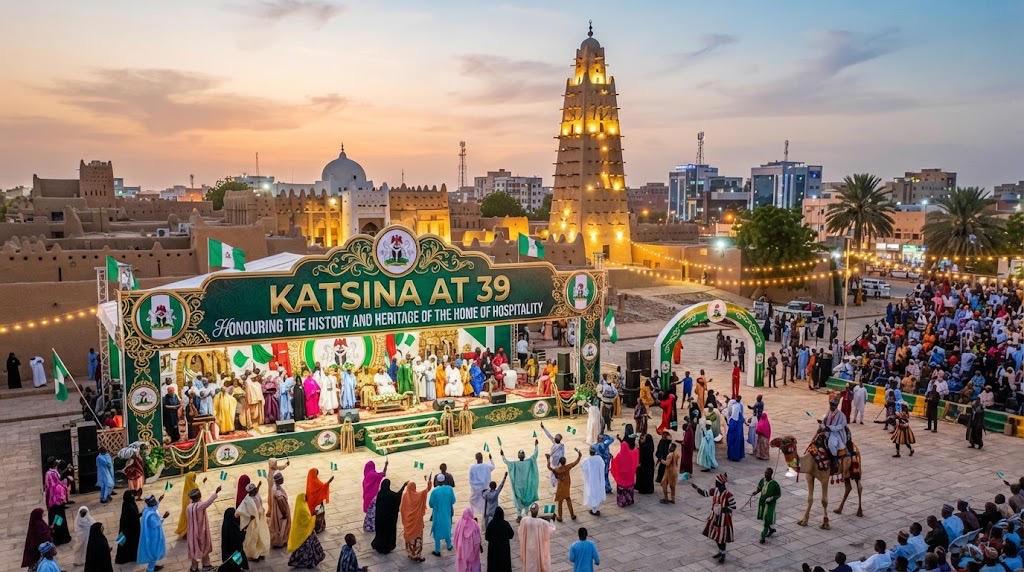
Calling Katsina a young state has always required a certain generosity with the word “young.” Thirty-nine years old by administrative record, certainly, but the city at its heart was already a centre of trans-Saharan trade and Islamic scholarship centuries before Nigeria existed as a political concept, let alone one with states to create. September 23, 1987 is when General Ibrahim Babangida’s restructuring exercise formally separated Katsina from the old Kaduna State, and today marks thirty-nine years since that decree took effect. Yet walk through the old city, past Kofar Yandaka toward the emir’s palace, and the anniversary reads less as a founding moment than as a footnote to a much longer history. Katsina has rarely needed to ask who it is. What 1987 provided was the administrative authority to govern itself.
Roots That Run Deeper Than the State Itself
Katsina’s claim to historical weight doesn’t need embellishing. Long before European traders reached the West African coast, Katsina city sat on the trans-Saharan trade routes, exchanging goods, ideas, and scholarship with North Africa and beyond. It became one of the Hausa states’ great centres of Islamic learning, producing scholars whose reputations travelled as far as Timbuktu.
The Gobarau Minaret stands as the physical proof of that inheritance. Built in the fifteenth century and later renovated under various emirs, it remains one of the oldest structures of its kind in West Africa, a tower that once anchored a Quranic learning centre attracting students from across the region. It’s not a museum piece behind glass somewhere. It sits in the old city, near Kofar Yandaka, still recognisably part of daily life, the kind of landmark residents walk past on their way to the market without necessarily stopping to marvel at what it represents.
Then there are the emirates. The Katsina Emirate and the neighbouring Daura Emirate, the latter tracing its origins to the legendary Bayajidda story that sits at the root of Hausa political history, aren’t ceremonial leftovers. Traditional institutions here still command genuine authority, and the recent decision by Governor Radda’s administration to upgrade the grading of district and village heads under the Emirate Law tells you something about how seriously the state still takes that structure. Durbar festivals, the Hawan Sarki processions with horsemen from dozens of districts parading in full regalia, aren’t tourist theatre either. They’re a living demonstration of a hierarchy that has organised Katsina society for centuries and shows no sign of fading.
A State That Punches Above Its Weight in National Politics
If there’s one thing Nigerians outside Katsina know the state for, it’s producing leaders. The late President Umaru Musa Yar’Adua, born in Katsina city into one of its most prominent political families, brought a reputation for quiet integrity to the presidency that outlasted his short and difficult tenure. Muhammadu Buhari, also a son of Katsina, went further still: a former military head of state who returned decades later as a civilian president, serving two full terms and becoming, for better or worse, one of the most consequential political figures of Nigeria’s Fourth Republic.
That’s an unusual concentration of national leadership for a single state to produce, and it isn’t accidental. Katsina’s elite have long understood the value of education and administrative training, dating back to institutions established in the colonial period that fed generations of civil servants, military officers, and eventually politicians into national life. The state’s political class today still operates in that shadow, aware that Katsina’s name carries weight in Abuja that smaller or newer states can’t easily match.
Modern Governance Under Dikko Radda
Governor Dikko Umaru Radda inherited a state with real structural problems: a civil service in need of discipline, an economy too dependent on subsistence agriculture, and a security situation in the rural north and west of the state that had displaced thousands of families. His response has been organised around what his government calls the “Building Your Future” agenda, and it’s worth being specific about what that has actually meant in practice.
Cleaning Up the Civil Service
Radda’s reform of the state bureaucracy hasn’t been cosmetic. His administration introduced competency examinations for permanent secretary appointments, run by the Public Service Institute of Nigeria rather than decided by patronage alone. Several recent permanent secretary appointments, including that of the NUJ state chairman Tukur Hassan Dan Ali, came through that merit-based process rather than the usual political horse-trading. It’s a small procedural change with an outsized signal: that access to the top of the civil service in Katsina now runs through demonstrated competence, not just connections.
Backing Small Business
The state’s MSME support has moved beyond speeches into actual disbursement. Under the ₦200 million Building Your Future Programme, more than a thousand young people across all thirty-four local government areas received startup capital. Hundreds more accessed interest-free loans through partnerships with Sterling Bank and the Bank of Industry. The KASEDA-NATA Mechatronics Apprenticeship Support Programme, meanwhile, has put three thousand young people through automobile and mechanical trade training, with over a thousand graduates already receiving starter packs to launch their own workshops.
Security Built From the Community Up
Rather than relying solely on military deployment, which has had mixed results across the wider northwest, Radda’s government established the Katsina Community Watch Corps, pairing conventional security operations with grassroots intelligence gathering, local vigilantes, hunters, and religious leaders who understand their own communities better than any outside force could. The administration has also pursued reintegration programmes for repentant bandits in areas like Jibia, offering business support, cattle, and industrial tools rather than punishment alone, betting that economic alternatives will do more to end the cycle of violence than force can achieve on its own.
Investing in People: Education, Youth, and Agriculture
None of the infrastructure or governance reform matters much without human capital to sustain it, and this is where Katsina’s current administration has placed some of its heaviest bets.
- Basic education: Teacher recruitment has been a stated priority, filling gaps in a public school system that had been stretched thin for years.
- Youth engagement: Beyond the mechatronics programme, thousands of young people have been absorbed into community watch and peacebuilding roles, giving them a stake in local security rather than leaving them as potential recruits for armed groups.
- Agricultural modernisation: With Funtua and Malumfashi long serving as the state’s agricultural backbone, the push now is toward better inputs, mechanisation, and value-chain support rather than simply expanding acreage.
- Budgeting from the ward level: The 2026 budget was built on community needs assessments across all 361 wards, with each community receiving direct allocation toward locally identified priorities, a genuinely unusual level of granularity for state-level budgeting in Nigeria.
Discover More of Katsina
Reading about the Gobarau Minaret or the Hawan Sarki durbar is one thing. Finding the hotels, restaurants, markets, and service providers that make a visit to Katsina actually work is another. Explore the best of Katsina on the Nigeriawide directory for a curated list of places worth your time, whether you’re a resident rediscovering your own state or a visitor planning your first trip to the Home of Hospitality.
Looking Toward Fifty
Katsina at 39 isn’t a state pretending the difficult years didn’t happen. Displacement, banditry, and economic pressure have tested the “Home of Hospitality” in ways its founders in 1987 never anticipated. But there’s a resilience here that predates the state itself, built into a city that has absorbed trade routes, empires, colonial administration, and independence, and kept its identity intact through all of it.
The next decade will likely be judged on whether the civil service reforms outlast this administration, whether the MSME investments translate into a genuinely diversified economy, and whether the community-driven security model can hold as banditry pressures shift elsewhere in the northwest. On current form, Katsina isn’t waiting passively to find out. It’s already building toward it, one ward, one apprentice, and one permanent secretary exam at a time.
Want to see the Home of Hospitality beyond the headlines? Explore the best of Katsina on our directory for hotels, local businesses, and hidden gems worth visiting across the state.

Add Comment