
- September 23, 2026
- 7
- Society
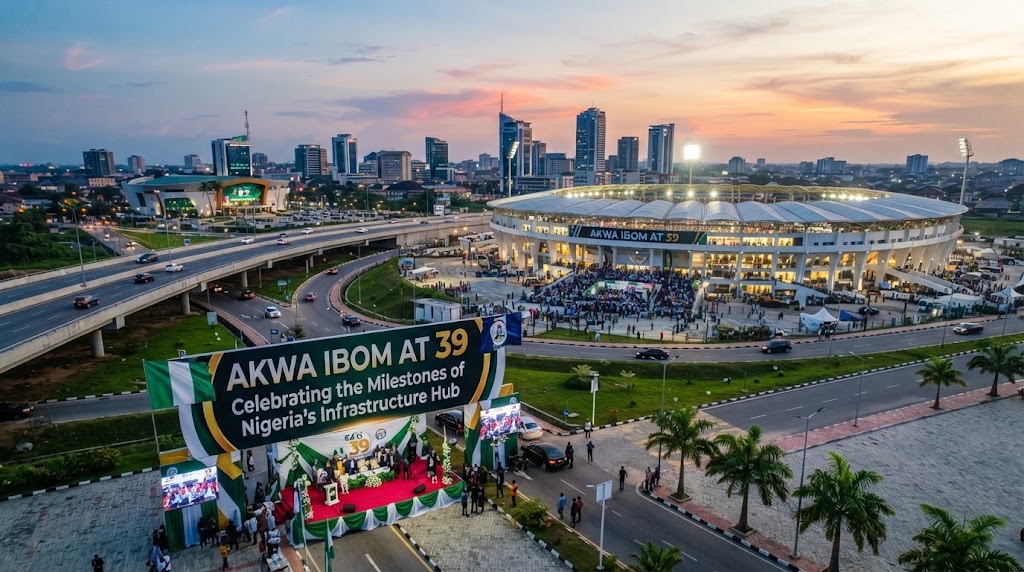
Thirty-nine years ago today, on September 23, 1987, General Ibrahim Babangida signed the decree that carved Akwa Ibom out of the old Cross River State. That single stroke of a pen changed the fortunes of millions of people who had spent decades asking Abuja, politely at first and then insistently, to be seen. Today, that anniversary lands differently. Walk through Uyo this morning and you will find flags out, church bells competing with highlife music from roadside speakers, and a kind of quiet pride that doesn’t need to shout to be felt. From Eket to Ikot Ekpene, from the creeks of Oron to the boardrooms of the state secretariat, September 23 is not just a date on a calendar. It is the day Akwa Ibom people remind themselves, and everyone watching, what thirty-nine years of persistence can build.
The Long Road to State Creation
The story of Akwa Ibom’s birth did not begin in 1987. It began decades earlier, in the frustration of the Ibibio, Annang, Oron, and Eket peoples who found themselves administratively swallowed within a much larger Cross River State, their distinct identity and needs often an afterthought in Calabar. Founding fathers such as the late Senator Paul Uduofot and other regional leaders spent years agitating, petitioning military administrations, and building the political case that this corner of the old Eastern Region deserved its own government, its own budget, and its own voice.
It was not an easy campaign. Nigeria’s history of state creation has always been tangled up with ethnic politics, resource control, and the anxieties of those who stood to lose territory or influence. But the argument for Akwa Ibom rested on something simple: a population large enough, a cultural identity distinct enough, and a landmass rich enough in both agricultural potential and oil wealth to justify standing on its own. When Babangida’s Political Bureau eventually recommended the creation of new states as part of a broader restructuring exercise, Akwa Ibom was one of nine states created that day, alongside old rivals and new neighbours. Uyo, then a relatively sleepy administrative town, was named the new capital.
The Infrastructure Revolution
What has happened since is where the real story lives, and it’s why Akwa Ibom has earned a reputation many older, wealthier states still envy.
Uyo: From Backwater to Blueprint
Anyone who visited Uyo in the 1990s and returns today would struggle to reconcile the two images in their head. The transformation didn’t happen by accident. Successive administrations, beginning notably under Obong Victor Attah and accelerated under Governor Godswill Akpabio, poured resources into turning the capital into something resembling a properly planned city rather than an overgrown village. Wide, well-lit dual carriageways. Roundabouts with actual landscaping. Drainage systems that, while not perfect, at least attempt to manage the punishing rains of the Niger Delta.
The Godswill Akpabio International Stadium remains the most visible symbol of that era, a 30,000-seat facility that put Uyo on the continental football map when it hosted CHAN matches. But it’s the unglamorous stuff — the road networks connecting Uyo to Ikot Ekpene, Eket, and the smaller towns in between — that ordinary residents point to when asked what state creation actually delivered for them.
Ibom Air and the Aviation Story
If there’s one achievement that has genuinely surprised the rest of Nigeria, it’s aviation. Ibom Air launched in 2019 as a state-owned airline in a country where such ventures usually collapse within a year or two, weighed down by mismanagement and political interference. Instead, it grew into one of Nigeria’s most reliable domestic carriers, expanding its fleet, its route network, and its reputation for punctuality in an industry not exactly known for it.
None of that happens without the Victor Attah International Airport, the facility that gave the state its own gateway rather than forcing travellers to route through Calabar or Port Harcourt. The airport has continued to expand its capacity, and the addition of a Maintenance, Repair and Overhaul (MRO) facility is arguably the more consequential development, even if it gets less attention than the airline itself. An MRO hub means aircraft servicing work, skilled jobs, and revenue that would otherwise leave the country entirely for facilities in South Africa, Ethiopia, or the Gulf. It’s the kind of long-game infrastructure bet that doesn’t photograph as well as a new terminal but matters more over a decade.
The Seaport Ambition
The other piece of the puzzle, still very much in progress, is the Ibom Deep Seaport. A state with roughly 129 kilometres of Atlantic coastline and no functioning deep seaport of its own has always been leaving money on the table, and successive governments have known it. The vision is straightforward: a facility capable of handling the kind of vessel traffic that currently bypasses Akwa Ibom for Lagos or Port Harcourt, unlocking industrial and maritime activity that could reshape the state’s economy for a generation. Progress has been slower than the aviation story, as deep seaport projects tend to be everywhere in the world, but the ambition hasn’t dimmed.
Under Governor Umo Eno: Agriculture, Rural Life, and the ARISE Agenda
The current chapter belongs to Governor Umo Eno, whose administration has organised its priorities around what it calls the ARISE Agenda — Agriculture, Rural development, Infrastructure maintenance, Security, and Education.
- Agricultural revolution: Food security has become a genuine policy focus rather than a campaign slogan, with the administration pushing initiatives aimed at boosting local production and reducing the state’s reliance on food imported from the north.
- Rural development: Roads and facilities in local government areas long ignored by previous budgets — think Ini, Ukanafun, Etim Ekpo — are finally getting attention, not just the flashier Uyo-centred projects.
- Fiscal discipline: The 2026 budget, tagged the “People’s Budget of Expansion and Growth,” commits roughly 75 percent of a N1.39 trillion appropriation to capital expenditure, a ratio that signals where the administration’s priorities genuinely sit.
Governor Eno has been candid that his government inherited dozens of unfinished projects and has made completing them, rather than launching new vanity schemes, a point of principle. It’s a less glamorous approach to governance, but residents who’ve watched half-built health centres sit abandoned for years tend to appreciate it.
Culture, Cuisine, and the Coastline
No account of Akwa Ibom is complete without its softer power: tourism and food. Ibeno Beach remains one of the finest, least crowded stretches of coastline in the country, a place where the Atlantic meets a kind of unhurried calm you don’t find in Lagos or Port Harcourt. Inland, the state’s cultural festivals and masquerade traditions still draw visitors and diaspora returnees every December.
And then there’s the food. Akwa Ibom’s culinary identity, built around dishes like afang and editan, alongside the broader South-South staple of edikang ikong, has become genuinely national property, showing up on menus in Lagos, Abuja, and London restaurants run by Nigerians proud to claim it. Few things unite Akwa Ibom people across religious, political, and generational lines quite like an argument over whose mother makes the best afang soup.
What the Next Decade Should Bring
Thirty-nine years in, Akwa Ibom’s founding argument has largely been vindicated. A state carved out on the promise of self-determination has built an airline, transformed its capital, and started conversations about maritime infrastructure that would have sounded fanciful in 1987. The unfinished business is real too: the seaport needs to move from vision to concrete and steel, rural infrastructure needs the same attention Uyo received in earlier decades, and the state’s oil-dependent revenue base still needs genuine diversification if the next generation is to inherit something more durable than pipeline royalties.
But there is a reason “Land of Promise” has stuck as the state’s identity rather than curdling into irony. Forty is close enough now to feel real, and if the last decade is any indication, Akwa Ibom seems intent on spending the next one collecting on that promise rather than simply repeating it.
Want to see the Land of Promise beyond the headlines? Explore the best of Akwa Ibom on our directory for hotels, local businesses, and hidden gems worth visiting across the state.


Add Comment