
- November 23, 2026
- 5
- Business
Industrial steel is the fundamental backbone of modern infrastructure. From high-rise commercial architecture and transcontinental railway systems to bridge girders, maritime ports, and heavy equipment fabrication, a nation’s capacity to construct durable public works depends heavily on domestic steel production.
For decades, Nigeria has relied almost entirely on imported structural steel to meet its expanding construction and urban development demands. This heavy import reliance consumes billions of dollars in foreign exchange annually and leaves major national infrastructure projects vulnerable to global supply chain shocks.
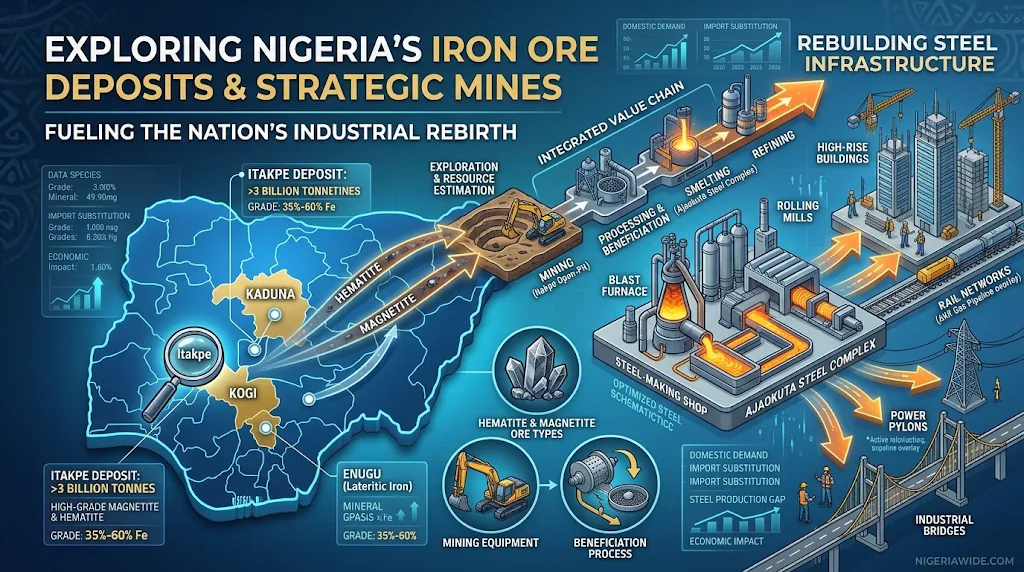
However, beneath Nigeria’s geological landscape lies a massive, underutilized asset: over 3 billion metric tonnes of commercial-grade iron ore reserves. Tapping into these strategic deposits is central to building an integrated national steel manufacturing framework.
The Strategic Importance of Iron Ore to Nigeria’s Economy
Iron ore is the essential raw mineral required for crude steel production. As Sub-Saharan Africa’s largest economy, Nigeria’s demand for structural rebar, wire rods, steel plates, and specialized machinery components continues to grow driven by rapid urbanization and large-scale transportation projects.
Developing local iron ore extraction and processing networks offers several transformative economic advantages:
- Foreign Exchange Preservation: Local steel production reduces the foreign currency drained by importing finished steel billets, structural beams, and heavy industrial machinery components.
- Industrial Sector Integration: Domestic iron ore feeds directly into local blast furnaces and direct reduced iron plants, supporting automobile assembly plants, manufacturing foundries, and agricultural tool fabrication.
- Job Creation along the Mining Belt: Transitioning from raw deposit mapping to active mining and beneficiation creates thousands of technical roles across geology, metallurgy, transport logistics, and heavy equipment mechanics in host communities.
Hub Guide Reference: This report is part of our comprehensive resource series on Nigeriawide. To see how iron ore compares to petroleum, natural gas, lithium, and gold, read our flagship hub article: Top 10 Most Valuable Natural Resources in Nigeria.
Geological Profile: Where Nigeria’s Major Iron Ore Deposits Lie
Nigeria’s iron ore reserves are primarily located across the Middle Belt, North-West, and South-East geological zones. The deposits exist in two distinct geological forms: high-grade banded iron formations (BIF) and sedimentary oolitic ironstones.
1. Kogi State (The Itakpe and Agbaja Belts)
Kogi State serves as the heart of Nigeria’s iron ore sector. It holds the largest concentrated reserves of both high-grade banded iron formation and massive sedimentary ironstone deposits.
- Itakpe Deposit: Located near Okene, Itakpe contains over 300 million tonnes of high-grade magnetite and hematite iron ore. It was specifically developed as the primary ore source for national steel processing hubs.
- Agbaja Plateau Deposit: Situated on a high plateau near Lokoja, Agbaja holds an estimated 1.2 to 2 billion tonnes of oolitic ironstone. Its vast scale makes it one of the largest single iron deposits in West Africa.
2. Kaduna State (Gueni and Birnin Gwari Deposits)
Kaduna State possesses rich reserves of banded iron formations around the Gueni and Birnin Gwari districts. These deposits are high in iron content and are increasingly attracting private investment for local processing and pig iron production.
3. Enugu State (Udi Hills Sedimentary Belt)
Enugu State holds substantial sedimentary iron ore reserves along the Udi Hills ridge. Historically explored alongside regional coal deposits, these ironstones offer key raw materials for industrial applications across the South-East region.
4. Niger, Zamfara, and Benue Belts
Additional commercial deposits of iron ore are distributed across Niger, Zamfara, and Benue states. These reserves provide vital opportunities for regional extraction clusters to supply localized steel rolling mills and industrial foundries.
The Ajaokuta Steel Complex and Itakpe Infrastructure Axis
The story of Nigeria’s iron ore industry is inextricably linked to the Itakpe-Ajaokuta industrial corridor. Designed as an integrated industrial network, the setup was built to mine raw ore at Itakpe, process it through a beneficiation plant to raise its iron concentration, and transport it directly to the Ajaokuta Steel Complex.
The Role of Itakpe Iron Ore Mining Company
The National Iron Ore Mining Company (NIOMCO) at Itakpe was established to extract and upgrade raw iron ore containing approximately 35 percent iron up to a 64 to 68 percent concentrate. This high-grade concentrate is essential for feeding direct reduction furnaces and blast furnaces.
The Ajaokuta Steel Complex Integration
The Ajaokuta Steel Complex was constructed as a multi-billion dollar integrated steelworks capable of producing millions of tonnes of crude steel annually. Restoring and fully operationalizing the link between the Itakpe mines, the Ajaokuta blast furnaces, and domestic railway transport remains the single most critical milestone for achieving national steel independence.
Railway Logistics (The Itakpe-Warri Rail Line)
Heavy freight logistics are critical for bulk mineral extraction. The commercial operation of the standard-gauge Itakpe-Ajaokuta-Warri railway line provides a direct corridor linking the mining hubs in Kogi State to the ocean ports at Warri, enabling efficient transportation of raw minerals, processed steel, and heavy machinery.
Technical and Operational Challenges Facing the Industry
Despite the vast quantity of raw ore in the ground, Nigeria’s iron ore sector faces key structural bottlenecks that have delayed full commercial optimization:
- Beneficiation Requirements: A significant portion of Nigeria’s sedimentary iron ore, particularly at Agbaja, contains elevated levels of phosphorus and silica. Processing these ores requires advanced metallurgical beneficiation techniques to remove impurities before smelting.
- Capital-Intensive Processing Infrastructure: Developing modern iron ore mines, crushers, concentrators, and blast furnaces requires continuous, long-term capital investment and stable international technical partnerships.
- Power Requirements: Smelting iron ore into crude steel requires massive, uninterrupted industrial electric power and thermal gas inputs. Expanding natural gas pipelines to mining zones is vital to running cost-effective processing plants.
The Path Forward: Strategic Priorities for Revival
To transform iron ore deposits into a fully functional steel industry, policy initiatives and private sector capital must target four key areas:
- Public-Private Partnerships (PPP): Engaging experienced international mining and metallurgical conglomerates to complete, modernize, and operate the Itakpe beneficiation facilities and Ajaokuta blast furnaces.
- Domestic Processing Mandates: Implementing mineral policies that discourage raw, unprocessed iron ore exports, encouraging investors to construct local pig iron and direct reduced iron (DRI) plants instead.
- Integration with National Gas Frameworks: Connecting iron ore processing hubs directly to the domestic natural gas network, such as the Ajaokuta-Kaduna-Kano (AKK) gas pipeline, to ensure affordable thermal energy for smelting.
- Support for Private Steel Mills: Encouraging local private steel manufacturing operations across Lagos, Ogun, Kano, and Enugu states to integrate backward into domestic iron ore mining rather than relying exclusively on imported scrap metal and steel billets.
Unlocking Nigeria’s iron ore potential is a national economic imperative. By building an integrated supply chain—from the rich deposits of Itakpe and Kaduna directly into local steel manufacturing—Nigeria can secure the structural materials required to build its bridges, railways, and cities for generations to come.
Hub Guide: This analysis is part of our comprehensive natural resource series. Discover how iron ore compares to oil, gas, gold, and other strategic assets in our main guide: Top 10 Most Valuable Natural Resources in Nigeria.
Explore Nigeria’s Iron Ore & Steel Hubs on Nigeriawide
The ongoing revitalization of Nigeria’s metallurgical and solid minerals sector is turning industrial corridors across Kogi State—anchored by Itakpe and Ajaokuta—into active destinations for engineering consultants, infrastructure investors, and industrial developers. Because these strategic iron ore deposits and processing complexes sit along the central Niger-Benue confluence, executing a productive site visit requires well-coordinated travel logistics from the outset.
Whether you are leading an international technical delegation or conducting an interstate facility audit, streamlining your transit is the critical first step. The Itakpe–Ajaokuta industrial corridor is most efficiently reached by flying into Abuja or Asaba before connecting by road along the central highway network. You can instantly compare domestic flight schedules and secure your corporate transit through the Nigeriawide Flight Booking Portal for a smooth arrival.
Once your travel dates are confirmed, use the Nigeriawide Discovery Guide to organize the rest of your itinerary. Our verified destination maps connect you directly to secure business-class hotels in Lokoja and Abuja, top-rated restaurants for executive meetings, and reliable 4×4 car rental services suited for industrial and mining site visits. Plan your trip with us to ensure your operations across Nigeria remain safe, efficient, and productive.

Add Comment