
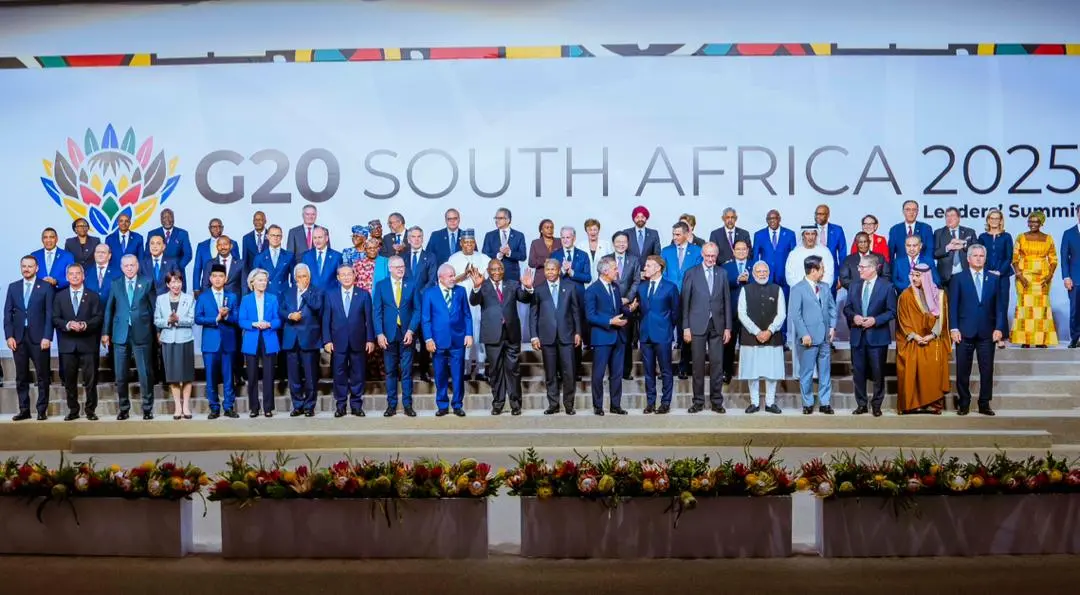
JOHANNESBURG, SOUTH AFRICA—President Bola Ahmed Tinubu has issued a powerful call for global equity in the trade of critical minerals and the governance of Artificial Intelligence (AI), stressing that Africa’s wealth must translate into shared prosperity for its people.
Represented by Vice President Kashim Shettima at the Third Session of the 2025 Group of 20 (G20) Leaders’ Summit in Johannesburg, President Tinubu articulated Nigeria’s stance on key global issues under the theme, “A Fair and Just Future for All: Critical Minerals, Decent Work, Artificial Intelligence.”
Critical Minerals: Calling for Value Addition at Source
President Tinubu emphasized that for Nigeria and Africa, critical minerals are the foundation for industrial transformation, but their possession alone doesn’t guarantee prosperity. He demanded a global framework that ensures host communities fully benefit from the created wealth.
“Nigeria calls for a global framework that promotes value addition at the source, supports local beneficiation and ensures that communities hosting these resources are not left behind,” the President stated. He cautioned that the issue “reaches far beyond the narrow arithmetic of economics and speaks to the moral character of the world we aspire to build.”
He stressed that responsible management of mineral wealth must be underpinned by fairness, transparency, and accountability to ensure the profits translate into shared progress.
Ethical AI Standards and Decent Work
Addressing the rapid advancement of technology, President Tinubu reaffirmed Nigeria’s support for creating global ethical standards for AI.
“We must ensure that AI becomes a tool of empowerment, not exclusion; of job creation, not displacement,” he warned, underscoring that AI must remain a servant of humanity and not a force that marginalizes the vulnerable. To unlock its benefits for developing nations, he urged G20 members to confront systemic bias and promote sustained multilateral dialogue.
On the transition towards a future-ready workforce, the President insisted that development must remain people-centered, with “Decent Work” as the anchor for transitions that are fair, inclusive, and sustainable. He highlighted Nigeria’s investments under the Renewed Hope Agenda in future-ready skills, including digital literacy, vocational training, and entrepreneurship.
Urgent Reform of Global Financial Architecture
President Tinubu also tackled the persistent challenges faced by the Global South, calling for a more equitable and responsive international financial system to manage global financial flows and address recurring debt crises.
He expressed concern that existing multilateral frameworks, built in an “era far removed from today’s complexities,” no longer reflect present realities.
“For trade to be truly inclusive, the G20 must take bold and deliberate steps towards reforming the international financial architecture and the global institutions that sustain it,” he asserted. The President urged G20 leaders to place debt sustainability and the responsible utilization of critical minerals at the heart of the inclusive development agenda.
He concluded by stressing that Africa’s development needs sustainable financing and cannot rely on aspiration alone, warning that rising debt burdens are pulling economies into cycles of fragility. The collective goal, he said, must be a future where Africa is not merely a supplier of raw materials but a continent of value creation, innovation, and dignified work.




Add Comment