
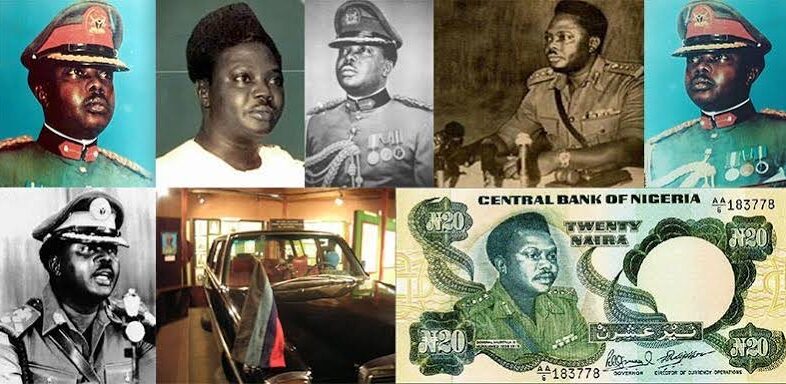
Murtala Ramat Muhammed was a pivotal figure in Nigeria’s history, a military general whose brief but impactful tenure as Head of State from July 1975 to February 1976 left an indelible mark on the nation. Remembered for his decisive leadership, anti-corruption drive, and commitment to a swift return to civilian rule, he remains a revered national hero.
Early Life and Education (1938-1959)
Born on November 8, 1938, in the Kurawa Quarters of Kano City, Kano State, Murtala Ramat Muhammed hailed from a ruling-class religious family. He was one of eleven children born to Risqua Muhammed and Uwani Rahamat. His early education included attendance at Cikin Gida and Gidan Makama primary schools in Kano. He later proceeded to Kano Middle School (now Rumfa College, Kano) in 1949 before attending the prestigious Government College (now Barewa College) in Zaria, where he obtained his school certificate in 1957. It was during his time at Barewa College that he joined the cadet corps, signaling his early interest in a military career.
Military Career and Rise to Power (1959-1975)
Muhammed officially began his military training in 1959. Like many Nigerian officers of his generation, he trained at the Royal Military Academy Sandhurst in England and was commissioned as a Second Lieutenant in 1961. He specialized in the army’s Signals Corps and underwent further advanced signals courses at the Catterick School of Signals in England.
His early military career saw him serving in the Nigerian contingent to the United Nations’ Peacekeeping Force in Congo in early 1962. Upon his return, he served as Aide-de-Camp (ADC) to M.A. Majekodunmi, the federally appointed administrator of the Western Region. He steadily rose through the ranks, becoming a Captain in 1963 and a temporary Major by late 1964.
Muhammed played a crucial role in the counter-coup of July 1966, which was a response to the January 1966 coup. This period was marked by significant political instability and ethnic tensions. During the Nigerian Civil War (1967-1970), he was appointed the first General Officer Commanding (GOC) of the Second Infantry Division. His command was instrumental in various operations, though some actions, such as the Asaba Massacre in October 1967, remain controversial aspects of his wartime record. After the civil war, he returned to head the Signals Corps and later served as a Federal Commissioner in the military government.
On July 29, 1975, while General Yakubu Gowon was attending an OAU summit in Kampala, Uganda, Murtala Muhammed led a bloodless military coup that overthrew Gowon’s government. The coup was widely welcomed by Nigerians who had grown disillusioned with Gowon’s prolonged rule, perceived corruption, and unfulfilled promises of a return to civilian governance. Muhammed’s ascendancy to power was seen as a fresh start for the nation.
Head of State: Policies and Achievements (1975-1976)
Murtala Muhammed’s 198-day reign as Head of State and Commander-in-Chief of the Armed Forces was characterized by swift, decisive actions and a clear vision for Nigeria. He immediately embarked on a comprehensive reform program aimed at sanitizing the civil service and public institutions. Key aspects of his administration included:
- Anti-Corruption Drive: He launched a vigorous campaign against corruption, dismissing over 10,000 public officials and employees without benefits on grounds of age, health, incompetence, malpractice, or corruption. This purge aimed to restore public confidence in government.
- Return to Civilian Rule: A cornerstone of his agenda was an orderly transition to democratic governance. He announced a clear timetable for a return to civilian rule by October 1, 1979, and appointed a 50-man Constitution Drafting Committee, headed by Chief Rotimi Williams, to draft a new constitution.
- Creation of States: To address ethnic and administrative imbalances, he set up the Justice Ayo Irikefe panel, which recommended the creation of seven more states (Niger, Bauchi, Gongola, Benue, Ogun, Imo, and Bendel), bringing the total to 19 states in February 1976.
- New Federal Capital: Recognizing the congestion and security challenges of Lagos, he initiated plans for a new Federal Capital Territory. A panel led by Justice Akinola Aguda recommended Abuja, and Muhammed officially announced the decision to move the capital to a central federal territory just ten days before his assassination.
- Foreign Policy: His government pursued a dynamic and assertive foreign policy, particularly in Africa. His famous “Africa has come of age” speech at the OAU conference in Addis Ababa in January 1976 was a powerful declaration of African self-determination and a rallying cry against Western imperialism and apartheid in Southern Africa.
- Economic Reforms: He initiated a comprehensive review of the Third National Development Plan and encouraged the rapid expansion of the private sector into areas previously dominated by public corporations.
Muhammed’s “low profile” approach to governance, his disdain for flamboyance, and his commitment to “military alacrity” in resolving issues endeared him to many Nigerians.
Assassination (1976)
Murtala Muhammed’s transformative leadership was tragically cut short. On February 13, 1976, he was assassinated in an abortive coup attempt led by Lieutenant Colonel Bukar Suka Dimka. Muhammed was ambushed and killed in his car while on his way to work in Lagos. His death sent shockwaves across the nation and the African continent.
Family Life and Legacy
Murtala Muhammed was married to Ajoke Muhammed in 1963. He is remembered for his dedication to his family.
Despite his short time in office, Murtala Muhammed’s legacy is profound. He is widely regarded as a visionary leader who instilled a new sense of purpose and direction in Nigeria. His anti-corruption stance, his commitment to a structured return to civilian rule (which was honored by his successor, Olusegun Obasanjo), and his assertive foreign policy that championed African liberation movements, continue to be celebrated. His portrait adorns the Nigerian N20 note, a testament to his enduring impact and status as a national hero. The Murtala Muhammed Foundation (MMF) continues to promote his ideals and address contemporary challenges in Nigeria.


Add Comment