
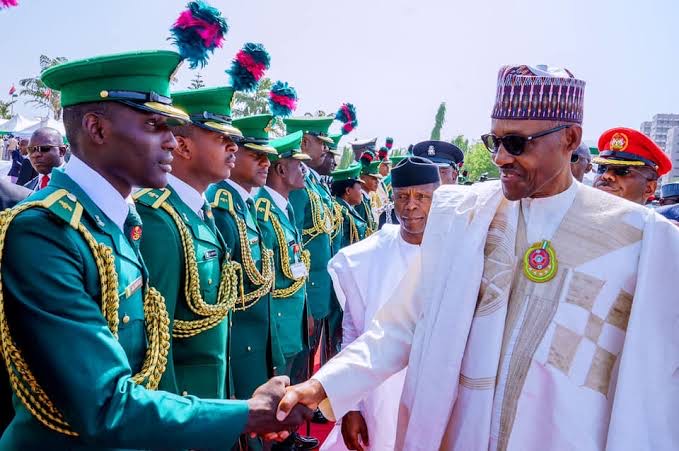
Muhammadu Buhari, a towering figure in Nigerian politics and military history, served as Nigeria’s military Head of State from 1983 to 1985 and later as the democratically elected President from 2015 to 2023. Known for his stern anti-corruption stance and a commitment to discipline, his career spanned decades of significant national events, including civil war, military coups, and the return to democratic governance.
Early Life and Education (1942-1961)
Born on December 17, 1942, in Daura, Katsina State, Nigeria, Muhammadu Buhari was the twenty-third child of his father, Mallam Hardo Adamu, a Fulani chieftain, and his mother, Zulaihat. Raised primarily by his mother after his father’s death when he was about four, Buhari’s early education began in Daura and Mai’adua from 1948 to 1952. He then attended Katsina Middle School in 1953, and Katsina Provincial Secondary School (now Government College, Katsina) from 1956 to 1961, where he earned his West African School Certificate.
Military Career and the Overthrow of Shagari (1961-1985)
Buhari’s military journey began in 1961 when he enrolled in the Nigerian Military Training College, Kaduna. His training continued at Mons Officer Cadet School in Aldershot, England (1962-1963), after which he was commissioned as a Second Lieutenant in January 1963. He held various command and staff positions throughout his distinguished military career, including Platoon Commander of the Second Infantry Battalion in Abeokuta, and later attended the Mechanical Transport Officers’ Course in England (1965), Defence Services Staff College in India (1973), and the United States Army War College (1979-1980).
He played a role in the 1975 military coup that unseated Yakubu Gowon, leading to his appointment as military governor of the North-Eastern State (now Borno) by General Murtala Mohammed. Following Murtala Mohammed’s assassination in 1976, General Olusegun Obasanjo appointed Buhari as the Federal Commissioner for Petroleum Resources. When the Nigerian National Petroleum Corporation (NNPC) was established in 1976, Buhari was appointed its chairman, a position he held until 1978.
On December 31, 1983, Major-General Muhammadu Buhari, then the General Officer Commanding (GOC) of the 3rd Armored Division, led a military coup that overthrew the democratically elected government of President Shehu Shagari. The coup, which was largely bloodless, cited widespread corruption, economic decline, and allegations of electoral malpractice as justifications for the military intervention. In an early-morning radio broadcast, the military announced the suspension of the constitution, closure of borders, and dismissal of all federal ministers. Buhari emerged as the Head of State and Commander-in-Chief of the Nigerian Armed Forces. His regime immediately implemented austerity measures to revive the economy and launched the “War Against Indiscipline” (WAI) program, aiming to promote positive values and combat corruption. However, his administration was also marked by restrictions on press freedom and political liberties. He was eventually overthrown in a military coup led by General Ibrahim Babangida on August 27, 1985, and subsequently detained until 1988.
Post-Military Rule and Political Aspirations (1985-2015)
After his release, Buhari retired to his residence in Daura. He later served as the Executive Chairman of the Petroleum Trust Fund (PTF) from 1994 to 1999, an agency praised for its transparency under his leadership.
Driven by a sense of national service, Buhari entered democratic politics in 2003, contesting the presidential election under the All Nigeria People’s Party (ANPP). He lost to incumbent President Olusegun Obasanjo. Undeterred, he ran again in 2007, also on the ANPP platform, losing to Umaru Yar’Adua. In 2010, he left the ANPP to help found the Congress for Progressive Change (CPC), under which he contested the 2011 presidential election, losing to Goodluck Jonathan. Throughout these campaigns, Buhari consistently championed an anti-corruption platform.
Presidency (2015-2023)
Buhari’s persistence paid off in 2015 when he emerged as the presidential candidate of the newly formed All Progressives Congress (APC). Campaigning on promises to tackle corruption, insecurity (particularly the Boko Haram insurgency), and economic challenges, he defeated incumbent President Goodluck Jonathan, marking the first time in Nigeria’s history that an opposition candidate had unseated a sitting president through democratic means. He was inaugurated on May 29, 2015, becoming the oldest president in Nigerian history at the time. He secured re-election in 2019, defeating Atiku Abubakar.
His presidency saw efforts to address Nigeria’s multifaceted challenges. Key achievements and initiatives during his tenure included:
- Infrastructure Development: An ambitious program including the completion of major rail projects (Lagos-Ibadan Standard Gauge Rail Line, Abuja-Kaduna Rail Line, Itakpe-Warri Standard Gauge Rail Line), significant road constructions (Lagos-Ibadan Expressway, Second Niger Bridge, Abuja-Kaduna-Zaria-Kano Expressway), and the establishment of the Infrastructure Corporation of Nigeria (InfraCorp) to mobilize capital for infrastructure growth.
- Economic Reforms: Implementation of the Treasury Single Account (TSA) to promote transparency in government finances and a renewed focus on anti-corruption efforts.
- Oil and Gas Sector: Enactment of the Petroleum Industry Act (PIA), which restructured the regulatory framework, and the transformation of NNPC into a limited liability company.
- Housing: Progress on the National Housing Programme with the completion of estates in several states.
- Legislative Reforms: Passage of several landmark bills, including the Electoral Act (Amendment) Act, 2022, and the Companies & Allied Matters Act (CAMA), 2020.
Despite these efforts, his administration also faced significant challenges, including persistent security issues (Boko Haram, banditry, and communal conflicts), economic recession, high inflation, and a growing national debt. His health was also a concern during his second term, leading to extended periods of medical treatment abroad.
Post-Presidency and Demise (2023-2025)
After completing his two terms, Muhammadu Buhari handed over power to his successor, Bola Ahmed Tinubu, on May 29, 2023. He retreated largely from public life, continuing to be a respected elder statesman.
Muhammadu Buhari passed away on July 13, 2025, in London, United Kingdom, at the age of 82.
Family Life
Muhammadu Buhari was married twice. He first married Safinatu Yusuf in 1971, and they had four daughters (Zulaihat, Fatima, Hadiza, Safinatu) and one son (Musa). They divorced in 1988. In 1989, he married Aisha Halilu, with whom he had four daughters (Aisha, Halima, Zahra, Amina) and one son (Yusuf). He is survived by his wife, children, and grandchildren.
Muhammadu Buhari’s legacy remains a subject of ongoing discussion, but his unwavering commitment to his vision for Nigeria, particularly his fight against corruption and his efforts to instill discipline, cemented his place as a prominent and often controversial figure in Nigeria’s contemporary history.


Add Comment