
- November 18, 2026
- 8
- Business
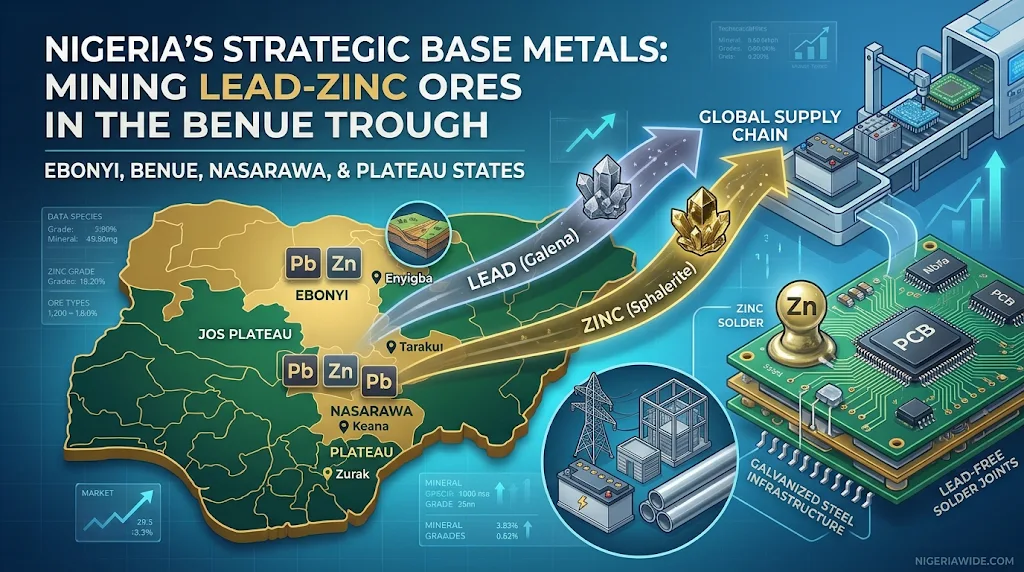
Nigeria holds vast mineral wealth beneath its soil, and among its most strategically critical solid mineral assets are lead and zinc ores. Occurring in close geological association, these base metal sulfides form a continuous belt across the nation’s interior, representing a multi-billion dollar industrial resource.
At the center of Nigeria’s base metal endowment is the Benue Trough, a major geological rift basin extending over 800 kilometers from the Niger Delta in the south to the Chad Basin in the northeast. This structural feature houses extensive lead-zinc mineralization, providing raw materials for energy storage, chemical processing, and structural manufacturing.
Understanding the geological distribution of lead-zinc deposits along the Benue Trough, their industrial applications, and the structural value chains required to commercialize them reveals key insights into Nigeria’s mining potential.
Geology and Distribution of Deposits in the Benue Trough
The Benue Trough is a major Cretaceous sedimentary basin formed by the tectonic rift evolution of the Gulf of Guinea. Mineralization along this belt is predominantly hydrothermal in origin, where mineral-rich saline fluids infill open fractures, fault zones, and shears within shales, sandstones, and limestones. The primary ore mineral for lead is galena (lead sulfide), while zinc occurs chiefly as sphalerite (zinc sulfide), frequently found alongside secondary minerals such as barytes, chalcopyrite, and silver.
Geologically, the Benue Trough is divided into three distinct segments, each exhibiting significant lead-zinc-baryte lodes:
The Lower Benue Trough is anchor to Nigeria’s most prominent and historically exploited lead-zinc field: the Abakaliki district in Ebonyi State. Major ore lodes across Enyigba, Ameri, Ameki, and Ishiagu contain high-grade galena and sphalerite veins. Proven and indicated reserves in this sector run into hundreds of thousands of tonnes of contained metal, with galena assays frequently yielding exceptionally high purity.
The Middle Benue Trough stretches across Benue, Nasarawa, Plateau, and Taraba states. Notable occurrences in areas like Azara, Arufu, and Akwana feature fracture-controlled vein systems where lead and zinc occur together with high-density baryte deposits. In this central sector, the geological structure reveals significant baryte enrichment alongside high-yield galena veins.
The Upper Benue Trough extends northeast through Bauchi, Gombe, and Taraba states, reaching toward the Chad Basin. Locations such as Zurak, Wase, and Gidan Dari host steeply dipping mineralized fracture zones. Deposits in this northern segment often display polymetallic characteristics, where lead and zinc are enriched with silver and trace gold.
Total estimated lead-zinc ore reserves across the entire Benue Trough belt exceed 10 million metric tonnes, making it one of Africa’s primary base metal corridors.
Key Commercial Applications of Lead and Zinc
The industrial value of lead-zinc ores stems from their distinct chemical and physical properties. Once mined, processed, and smelted into refined metals, lead and zinc serve as indispensable inputs for several global industries.
Industrial Uses of Lead Ores (Galena)
Lead’s density, corrosion resistance, malleability, and energy storage capacity drive its global industrial demand.
- Energy Storage Systems: Over 85 percent of global refined lead is consumed in the production of lead-acid batteries. These remain the standard technology for automotive starter batteries, industrial uninterruptible power supply (UPS) systems, telecom backup towers, and off-grid solar energy storage installations.
- Radiation Shielding: Due to its high atomic density, lead sheets and bricking are essential materials used to construct radiation barriers in medical imaging facilities, laboratories, and nuclear applications.
- Construction Materials and Alloys: Lead is used in specialized roofing membranes, acoustic soundproofing materials, heavy machinery bearings, and specialized solders.
- Precious Metal Extraction: Many Nigerian galena ores are argentiferous, meaning they carry economic quantities of silver. Smelting argentiferous lead allows refiners to recover high-value silver as a byproduct.
Industrial Uses of Zinc Ores (Sphalerite)
Zinc is essential for anti-corrosion applications, metallurgical alloys, and chemical manufacturing.
- Steel Galvanization: The primary commercial application for refined zinc is the galvanization of structural steel and iron. Coating steel in molten zinc prevents rust and atmospheric corrosion, extending the operational life of roofing sheets, construction beams, pipelines, and automotive frames.
- Brass and Bronze Alloys: Zinc is melted alongside copper to produce brass, an alloy essential for plumbing fittings, heat exchangers, valves, and electrical hardware.
- Chemical and Pharmaceutical Compounds: Zinc oxide derived from sphalerite concentrate is widely utilized as a vulcanizing agent in tire manufacturing, a UV-reflective active ingredient in sunscreens, and a component in pharmaceuticals and agricultural fertilizers.
- Die-Casting Components: Zinc alloys feature low melting points and fluid casting characteristics, making them ideal for precision die-cast parts in electronics, hardware, and automotive assemblies.
The Nigerian Lead-Zinc Value Chain
To convert raw underground veins into export revenue and local industrial capacity, the lead-zinc sector relies on a clear, step-by-step mineral value chain.
1. Exploration and Mineral Titling
The value chain begins with targeted geological exploration using core drilling, geochemical soil sampling, and geophysics to delineate mineralized vein structures. Investors and exploration firms acquire titles such as Exploration Licenses (EL) or Small-Scale Mining Leases (SSML) through the Nigerian Mining Cadastre Office (MCO) to secure legal extraction rights.
2. Mining Operations
Extraction across the Benue Trough occurs through both open-pit quarrying for shallow vein structures and underground shaft development for deeper hydrothermal lodes. While historical operations relied heavily on informal artisanal panning, the industry is increasingly adopting mechanized open-cast mining equipped with heavy excavators, rock breakers, and dewatering pumps to process higher volumes safely.
3. Beneficiation and Processing
Run-of-mine (ROM) ore from the pit cannot be exported or smelted directly due to waste rock and gangue minerals. Beneficiation plants process raw ore through crushing, grinding, gravity separation (using shaking tables and spirals), and froth flotation. Froth flotation separates galena and sphalerite into high-purity lead concentrates (typically containing 60 to 70 percent Pb) and zinc concentrates (50 percent+ Zn), satisfying international smelter specifications.
4. Smelting and Refining
In the traditional export model, processed lead and zinc concentrates are bagged and transported to sea ports for export to international refiners in Asia and Europe. However, the strategic growth objective for the Nigerian mining sector centers on establishing domestic primary smelters. Local smelting converts raw concentrate into refined lead ingots and zinc slabs, capturing full economic value, reducing freight costs, and creating skilled metallurgical jobs locally.
5. Downstream Integration and Manufacturing
The final link in the value chain connects refined metals directly to domestic manufacturing. Local lead ingots can feed domestic battery manufacturing plants, while refined zinc supports local galvanizing lines and steel mills. This reduces Nigeria’s reliance on imported industrial raw materials and builds domestic manufacturing capacity.
Overcoming Structural Bottlenecks in the Sector
Unlocking the full potential of lead-zinc deposits along the Benue Trough requires addressing several persistent operational challenges:
- Processing Infrastructure: A significant portion of mined ore is currently exported as raw or minimally processed mineral rocks. Expanding modern regional flotation and processing plants in mining hubs like Abakaliki, Azara, and Wase will prevent value loss and boost export earnings.
- Transportation and Logistics: Transporting heavy mineral concentrates from interior mining zones in Ebonyi, Nasarawa, and Plateau states to coastal ports requires reliable road and heavy rail networks. Expanding rail freight logistics will significantly reduce transport overheads for mining operators.
- Formalizing Artisanal Operations: Transforming informal mining groups into structured cooperatives provides miners with access to safer equipment, environmental safety training, and formal financial channels, mitigating environmental degradation and unsafe pit practices.
- Environmental Remediation: Historical lead mining in parts of the Middle and Lower Benue Trough has led to localized soil and water contamination. Enforcing mandatory Environmental Impact Assessments (EIA), safe tailing dam management, and pit reclamation safeguards local farming communities and water basins.
Strategic Outlook
The lead-zinc reserves of the Benue Trough represent a major base metal asset capable of supporting Nigeria’s broader industrialization agenda. As global demand for energy storage, durable building materials, and anti-corrosion coatings continues to climb, Nigeria’s rich galena and sphalerite deposits offer high-return opportunities for targeted exploration, localized mineral beneficiation, and industrial manufacturing.
By developing domestic processing capacity and expanding infrastructure along the Benue Trough, Nigeria can transform its lead-zinc deposits into a long-term economic engine.
Hub Guide: This sub-article connects directly to our master report on Nigeriawide: Top 10 Most Valuable Natural Resources in Nigeria. Read the full guide to explore Nigeria’s broader solid minerals, energy assets, and state-by-state geological profile.
Explore Nigeria’s Lead-Zinc Mining Corridors on Nigeriawide
Expanding commercial extraction and mineral processing along the Benue Trough is turning key mining districts across Ebonyi, Benue, Nasarawa, and Plateau states into high-activity hubs for exploration geologists, commodity buyers, and industrial investors. Because major galena and sphalerite lodes—from Enyigba and Ishiagu in the Lower Trough to Akwana, Arufu, and Zurak further north—span remote rural belts, executing a productive site visit requires careful travel coordination from the moment you plan your trip.
Whether you are coordinating an international investor delegation or conducting an on-site reserve evaluation, streamlining your transit is the essential first step. Mining corridors in the Lower Benue Trough are most efficiently accessed by flying into Enugu, while Middle and Upper Trough sites are best reached via Abuja, Makurdi, or Jos before continuing overland. You can instantly compare domestic schedules and secure your corporate transit through the Nigeriawide Flight Booking Portal for a seamless arrival.
Once your travel dates are set, use the Nigeriawide Discovery Guide to arrange the rest of your itinerary. Our verified destination maps connect you directly to secure business-class hotels in Abakaliki, Enugu, Lafia, and Jos, top-rated restaurants for corporate meetings, and dependable 4×4 car rental services built to navigate rugged mining terrain. Map out your journey with us to ensure your field operations across Nigeria remain safe, efficient, and successful.

Add Comment